
Is Your Business Ready for the August 2026 Vape WEEE Compliance Deadline?
A regulatory deadline that many UK businesses have overlooked is approaching fast. From 12 August 2026, vaping devices become a dedicated Waste Electrical and Electronic Equipment (WEEE) category in their own right — Category 15 — and a new set of compliance obligations will apply to anyone who places vape products on the UK market, distributes them, or handles them in significant quantities as part of their operations.
This is not a consumer issue. It is a business compliance issue. If your organisation sells vaping products through a company store, procures them as staff perks, operates vending facilities, or generates waste vape devices from your premises at scale, you need to understand your obligations now — not in July.
This guide explains exactly what Category 15 WEEE means for UK businesses, who bears responsibility under the updated WEEE Regulations, what the August 2026 deadline triggers, and how to build a compliant disposal pathway before enforcement begins in earnest.
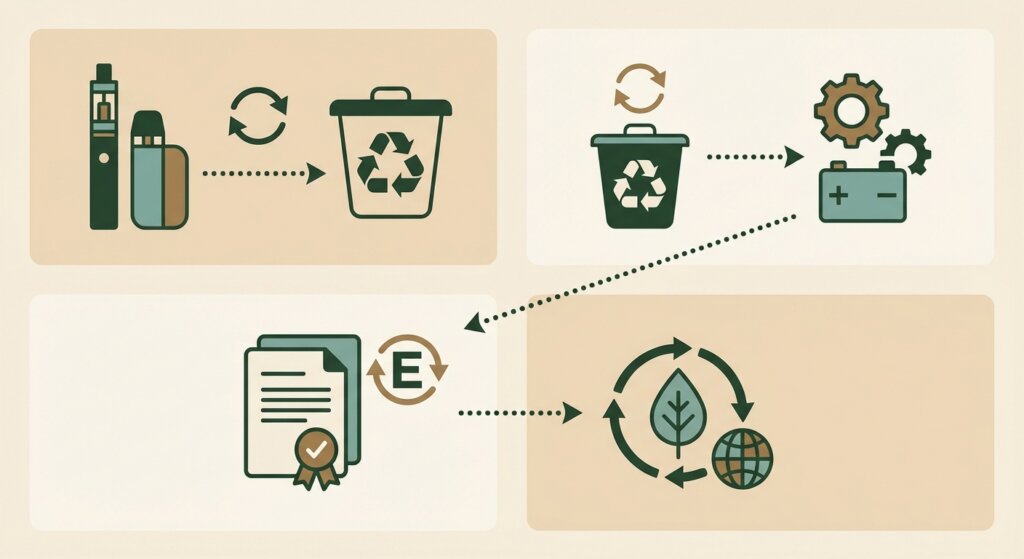
Vaping devices are discarded in the UK every single week — generating one of the fastest-growing streams of electronic waste the country has ever seen
What is Category 15 WEEE and Why Does It Exist?
The WEEE Regulations 2025 Amendment, which came into force in August 2025, introduced a 15th category to the UK's existing 14-category WEEE classification system. Category 15 is dedicated entirely to vaping devices — a recognition by government that vape waste has grown into a distinct and substantial waste stream that demands its own treatment infrastructure, reporting mechanisms, and producer funding arrangements.
Category 15 covers the following product types:
- Rechargeable vaping devices — refillable e-cigarettes, pod systems, and vape mods
- Vape pods and cartridges — prefilled pods and replacement cartridge assemblies containing electrical components
- Associated charging equipment — USB charging cables and docking units supplied with vaping devices
- Single-use e-cigarettes — now banned from sale in the UK since June 2025, but legacy stock and waste streams remain in scope
Before this reclassification, vaping devices were typically grouped within the existing WEEE categories covering small mixed electrical and electronic equipment — a broad category that made it difficult to set meaningful recycling targets or track producer compliance with any precision. Category 15 creates a ring-fenced reporting and funding structure specifically for vape waste, enabling regulators to set dedicated recycling targets and hold producers accountable in a way that was previously impractical.
The move was driven by a combination of environmental pressure — vapes contain lithium batteries, plastic casings, nicotine residue, and sometimes heavy metals — and the sheer scale of the problem. Industry estimates suggest that around 5 million vaping devices are discarded in the UK every week, many of them in general waste bins rather than through appropriate electrical waste collection points.
Important: Single-Use Vape Ban Context
Single-use disposable vapes have been banned from sale in England, Scotland, Wales, and Northern Ireland since 1 June 2025. Category 15 WEEE obligations do not change this. The focus for most businesses from August 2026 onwards will be on rechargeable vaping devices and the waste generated from any vape-related products that were lawfully placed on the market prior to the ban. Legacy stock and rechargeable devices remain fully in scope.
What Happens on 12 August 2026?
The 12 August 2026 date is significant because it is when specific recycling targets for Category 15 vape waste come into full effect. From this date, producers — meaning any business that manufactures vaping devices in the UK or imports them into the UK market — are required to fund the actual costs of collecting and recycling waste vapes through an approved compliance scheme.
To understand the timeline in full, it helps to look at each phase:
Phase 1: August 2025 — Regulatory Framework Established
The WEEE Regulations 2025 Amendment came into force in August 2025, formally creating Category 15 and introducing the legal basis for vape-specific producer obligations, distributor take-back requirements, and online marketplace liability. Producers were required to register with a compliance scheme or directly with the Environment Agency within 28 days of first placing vapes on the UK market.
Phase 2: March 2026 — Government Sets Recycling Targets
By 31 March 2026, the government was required to publish recycling targets specifically for Category 15 waste vapes. These targets are cascaded down to compliance schemes, who then apportion obligations among their registered members based on the volumes of vaping products each producer has placed on the market.
Phase 3: August 2026 — Full Cost Funding Obligations Activate
From 12 August 2026, producers must fund the full costs of collecting and treating waste vapes — not just a partial contribution. Combined with active recycling targets and a quarterly reporting requirement (producers must file detailed data on weights, categories, and volumes with their compliance scheme throughout 2026), this represents a significant step-change in regulatory rigour for the vape supply chain.
Phase 4: 2027 and Beyond — Full Cost Recovery
The 2026 regime represents partial costs for some producers. From 2027, full cost recovery is expected to apply across the board, meaning that the economics of vape compliance will become more demanding for those who have not yet built cost-effective disposal partnerships.
Pro Tip: Act Before the Deadline
Compliance scheme registration and supplier due diligence take time. Businesses that start their Category 15 compliance review in spring 2026 will be in a far stronger position than those who wait until August. The registration and reporting infrastructure needs to be in place before the targets activate, not after.
Which Businesses Are Affected by Category 15 WEEE?
The WEEE Regulations create obligations at two distinct points in the supply chain: producers and distributors. Understanding which category your business falls into is the first step in determining your compliance requirements.
Producers
Under the WEEE Regulations, a "producer" is any business that:
- Manufactures vaping devices in the UK under its own brand
- Resells vaping devices manufactured by others under its own brand
- Imports vaping devices into the UK for the first time
- Sells vaping devices to UK consumers or businesses from outside the UK via distance selling or online platforms
Producers bear the primary financial obligations under Category 15 WEEE. They must register with an approved Producer Compliance Scheme (PCS) — such as Valpak, ERP, or Beyondly — within 28 days of first placing vaping products on the UK market. They must then fund collection and recycling in proportion to the volume of devices they place on the market, report quarterly, and meet the recycling targets set by government.
Distributors
A "distributor" under the WEEE Regulations is any business that sells vaping devices to end users — whether consumers or businesses. Distributors face a different set of obligations:
- In-store take-back: Distributors selling vapes in a physical retail environment must offer in-store take-back, accepting waste vaping devices from customers returning products for recycling. Vaping products are notably exempt from the Distributor Take-Back Scheme (DTS), which means retailers cannot opt out of in-store take-back by joining the DTS — the obligation to accept vape returns applies regardless.
- Online distance selling: Online sellers of vaping products must provide customers with equivalent take-back options, ensuring that a consumer who purchases vapes online has a clear, accessible route to return waste devices for recycling.
- Duty of care documentation: Distributors must ensure that any vape waste they collect through take-back schemes is passed to an appropriately licensed waste carrier and ultimately treated by an approved facility.
Employers and Facilities Managers
If your organisation does not sell vaping products but generates vape waste from your premises — for example through staff using rechargeable vaping devices at work — your primary obligation is the general duty of care under waste legislation. Vaping devices are WEEE and cannot lawfully be placed in general business waste or general recycling streams. They must be segregated and disposed of through an appropriate WEEE collection route.
For most employers, this means ensuring that:
- Vaping devices are not placed in general waste bins or standard recycling
- A designated WEEE collection point is available on-site
- WEEE collection is handled by a licensed waste carrier with appropriate documentation
- Transfer notes and waste records are retained as evidence of compliance
Compliance Alert: Online Marketplaces Now Liable
The 2025 WEEE amendments introduced a significant extension of liability to online marketplaces. Where an overseas supplier sells vaping devices to UK buyers through a marketplace platform (such as eBay, Amazon Marketplace, or similar), the platform itself now bears WEEE producer obligations if the overseas supplier is not registered. This closes a major loophole that had allowed unregistered overseas vape suppliers to avoid UK compliance requirements entirely.
Why Vape WEEE Is a Distinct Environmental Problem
Understanding why vaping devices require their own WEEE category helps clarify the scale of responsibility involved. Vaping devices are not simply small electronic gadgets — they contain a combination of hazardous materials that make improper disposal genuinely damaging:
Lithium-Ion Batteries
All rechargeable vaping devices contain lithium-ion batteries. When these enter general waste streams — whether in landfill or in refuse collection vehicles — they present a significant fire risk. Lithium battery fires in waste vehicles and recycling facilities have caused millions of pounds of damage across the UK in recent years, and the rise of vape waste is a contributing factor. Lithium batteries must be separated from general waste and handled through specialist facilities equipped to process them safely.
Nicotine Residue
Many vaping devices retain residual nicotine-containing liquid at end of life. Nicotine is classified as a hazardous substance, and improper disposal can result in soil and groundwater contamination. The regulatory requirement to treat vape waste through appropriate facilities is partly driven by the need to manage this hazardous residue in a controlled environment.
Recoverable Materials
Vaping devices contain copper wiring, steel components, and recoverable plastics — all of which have value in the secondary materials market when properly processed. The Category 15 framework is designed to ensure these materials are extracted through a proper recycling process rather than lost to landfill. At a time when the UK is under pressure to improve circular economy performance, the recovery of materials from vape waste is both an environmental and economic priority.
"An estimated 5 million vaping devices are discarded in the UK every week. Without dedicated collection infrastructure, the majority end up in general waste — meaning their lithium batteries, nicotine residue, and recoverable metals are entirely lost to the environment."
Producer Compliance Schemes: What They Are and How They Work
For businesses with producer obligations under Category 15, registering with an approved Producer Compliance Scheme (PCS) is the primary compliance mechanism. A PCS acts as an intermediary between producers and the regulatory framework, managing the collective reporting, funding, and recycling target compliance on behalf of its members.
Here is how the PCS model works in practice:
Registration
Any business placing vaping devices on the UK market for the first time must register with a PCS within 28 days. Registration requires providing details of the types of vaping products supplied, estimated volumes, and business information. Approved PCS operators in the UK include Valpak, ERP UK, and Beyondly, among others.
Data Reporting
Registered producers must submit quarterly data reports to their PCS covering the weights and volumes of vaping devices placed on the UK market during that period. This data is used to calculate each producer's proportionate share of the collective recycling obligation, and is ultimately reported to the Environment Agency.
Financial Contribution
Based on the data reported, producers pay into the PCS to fund the collection and treatment of waste vapes. From 12 August 2026, this funding must cover the real costs of collection and treatment — not a subsidised partial rate. The PCS then uses this funding to contract with waste management operators who run collection points, process waste vapes, and provide the treatment services that meet the recycling targets.
Compliance Evidence
PCS members receive annual compliance certificates confirming that their obligations for the year have been met. These certificates are important evidence that a business has discharged its WEEE producer duties — they should be retained alongside other compliance documentation as part of a broader environmental compliance record.
Pro Tip: Choose a PCS With Vape-Specific Experience
Not all compliance schemes have equal experience with Category 15. When selecting a PCS, ask specifically about their vape waste collection infrastructure, their relationships with Category 15 treatment facilities, and their track record in reporting for small WEEE producers. A scheme with established vape recycling partnerships will generally deliver better value and smoother compliance than one that is adapting its general WEEE offering to the new category.
Duty of Care: What Employers and Facilities Managers Need to Do
Even if your business is not a vape producer or retailer, the introduction of Category 15 WEEE has practical implications for how you manage electronic waste generated on your premises. As vaping becomes more prevalent in the UK workforce, organisations that have not considered their WEEE duty of care for vape waste may find themselves exposed to regulatory risk.
The steps below are recommended for any organisation that generates vape waste from its operations:
Step 1: Conduct a Waste Stream Review
Identify whether vaping devices are currently entering your general waste or recycling streams. In many office environments this happens unnoticed — vape devices are small and easily dropped into desk bins alongside general waste. A brief audit of waste disposal practices and bin contents can reveal whether vape waste is a current issue that requires remediation.
Step 2: Establish a Segregated WEEE Collection Point
For premises where vape waste is generated, a designated small WEEE collection point should be made available. This can be as simple as a clearly labelled small electrical waste bin placed near kitchens or welfare areas — the important thing is that employees have an accessible, obvious route to segregate vaping devices from general waste. Clear signage should confirm that vaping devices are electrical waste and should not go into general bins.
Step 3: Include WEEE in Waste Carrier Contracts
Ensure that any waste carrier collecting from your site is licensed to handle WEEE and that your contract explicitly covers small electronic items including vaping devices. Request evidence of licensing — an upper-tier waste carrier licence from the Environment Agency — and confirm that the carrier passes WEEE to an appropriately permitted treatment facility rather than to landfill.
Step 4: Retain Transfer Notes
Waste transfer notes are the primary audit trail under the duty of care regime. You must receive a waste transfer note each time WEEE is collected from your site. These notes should be retained for a minimum of two years and should clearly identify the type of waste transferred (including WEEE), the licensed carrier, and the destination facility. In the event of an enforcement inspection, transfer notes are your principal evidence of compliance.
Step 5: Brief Employees on the Changes
Where facilities teams or office managers are responsible for waste compliance, a brief communication to employees about the correct disposal route for vaping devices can significantly reduce the risk of non-compliance. A simple notice on intranet pages or printed near waste collection points explaining that vaping devices are electrical waste and should be placed in the designated WEEE point — rather than in general bins — will address the majority of the inadvertent compliance risk in most office environments.
Vape WEEE Supplier Due Diligence for Procurement Teams
Procurement managers and facilities teams that source vaping products — whether for company welfare provisions, employee benefit schemes, or resale through company stores — have an additional layer of responsibility. From a due diligence perspective, the origin of the vaping products you procure, and whether your supplier is registered under Category 15 WEEE, matters.
If you purchase vaping devices from an unregistered overseas supplier through a marketplace platform and that platform has not assumed producer liability, the regulatory chain is broken. While liability for broken compliance chains generally falls on the unregistered producer rather than the downstream buyer, there can be secondary duty of care implications where procurement decisions knowingly support non-compliant supply chains.
Recommended due diligence steps for procurement teams include:
- Requesting PCS registration confirmation from any vape supplier as part of supplier qualification
- Including WEEE compliance warranties in procurement contracts and terms and conditions
- Preferring UK-registered suppliers or suppliers with demonstrable Category 15 registration over unverified overseas sources
- Documenting due diligence steps taken as part of your broader ESG or environmental compliance records
Penalties and Enforcement: What Non-Compliance Looks Like
Understanding the enforcement framework reinforces why Category 15 compliance is not optional. The penalties for WEEE non-compliance operate alongside separate penalties for failing to comply with the single-use vape ban, and the two regimes can overlap where a business is found to be both selling banned products and failing to meet its WEEE obligations.
Fixed Penalty Notices
For the single-use vape ban specifically, businesses caught selling or supplying disposable vapes after 1 June 2025 face a fixed penalty notice of £200, reduced to £150 if paid within 14 days. While this is the immediate sanction for vape retail violations, it is the gateway to more serious enforcement action for businesses that do not address the underlying compliance failure.
WEEE Regulation Penalties
Non-compliance with WEEE producer obligations can result in substantial financial penalties, operational disruption, and reputational damage. The Environment Agency and Trading Standards have powers to:
- Issue compliance notices requiring a business to take specific remedial action within a set timeframe
- Impose civil sanctions and financial penalties where obligations have not been met
- Refer cases to criminal prosecution for persistent or deliberate non-compliance, which can result in unlimited fines
- Investigate failures to provide requested information, which can attract fines of up to £5,000 on summary conviction
Reputational Risk
For businesses with ESG reporting obligations or sustainability commitments, WEEE non-compliance carries a reputational dimension that extends beyond regulatory fines. Supply chain audits, investor due diligence, and procurement qualification processes are increasingly examining environmental compliance credentials. A finding of non-compliance with basic electrical waste obligations — particularly for a business operating in a sector with high vape waste volumes — can have consequences well beyond the immediate penalty.
Building a Compliant Vape Waste Disposal Pathway
Whether your organisation is a producer, distributor, or simply a business generating vape waste on its premises, the practical question is the same: how do you ensure that your waste vaping devices are handled in a way that meets your legal obligations?
A compliant vape waste disposal pathway typically involves the following elements working in combination:
In-Facility Collection
For businesses generating vape waste at a fixed premises, the starting point is on-site collection infrastructure. Designated WEEE bins or containers, clearly identified as being for electrical waste only, provide the collection point from which vape waste can be safely consolidated before transfer to a licensed carrier.
Licensed Waste Carrier Collection
Vape waste must be collected by an upper-tier licensed waste carrier. When engaging a waste management provider, verify their Environment Agency carrier licence number and confirm that their licence covers WEEE specifically. A licensed WEEE carrier will provide waste transfer notes documenting the weight and category of waste collected, the collection date, and the destination facility. Innovent's WEEE recycling service operates under appropriate Environment Agency licensing, and our nationwide collection service can be incorporated into broader WEEE management programmes.
Approved Treatment Facility
Vape waste should be directed to a facility with appropriate permits for treating Category 15 WEEE. The treatment process involves safely discharging lithium batteries, separating hazardous components (including nicotine residue), and recovering recyclable materials such as metals and plastics. Your waste carrier should be able to confirm the name and permit number of the treatment facility to which they deliver Category 15 waste.
Documentation and Record-Keeping
A complete compliance record for vape WEEE disposal should include: waste transfer notes for each collection, confirmation of carrier licensing, evidence of treatment facility compliance, and — for producers — PCS registration confirmation and quarterly reporting records. This documentation should be filed alongside your broader environmental compliance records and retained for a minimum of two years, though a longer retention period is prudent for businesses subject to ESG or audit reporting. Our asset reporting and certification service provides the documentation framework businesses need to demonstrate compliance.
How Category 15 Fits into Your Broader WEEE Compliance Programme
For most organisations, vape waste is one component of a wider WEEE management challenge. IT equipment — computers, monitors, servers, networking hardware, and mobile devices — represents a far larger share of most businesses' electrical waste by volume and value. Category 15 is best approached not as a standalone compliance project, but as part of a comprehensive WEEE management review.
Businesses that already have a compliant IT WEEE disposal programme in place — with documented waste carrier contracts, transfer notes, and evidence of treatment at licensed facilities — are well positioned to extend that framework to cover Category 15 vape waste. The same principles apply: segregation at source, licensed carrier, permitted treatment facility, documented evidence chain.
If your organisation does not yet have a comprehensive WEEE compliance programme, the August 2026 Category 15 deadline is a useful prompt to address the broader picture. Our guide to WEEE collection services for UK businesses provides a practical overview of how to build a compliant programme from the ground up, and our post on WEEE 2026 retailer obligations covers the broader regulatory changes affecting UK businesses this year. For background on how the WEEE regulations have evolved, our overview of WEEE regulations 2026 changes for UK businesses provides useful context.
Key Takeaways
- Category 15 is a new dedicated WEEE classification for vaping devices, introduced by the WEEE Regulations 2025 Amendment, covering rechargeable vaping devices, pods, cartridges, and associated charging equipment.
- 12 August 2026 is the key deadline: from this date, producers must fund the full real costs of collecting and recycling waste vapes through an approved Producer Compliance Scheme (PCS).
- Producers must register with a PCS within 28 days of first placing vaping products on the UK market — if you manufacture or import vapes, registration is a legal requirement, not optional.
- Distributors selling vapes cannot opt into the DTS: all retailers selling vaping products must offer in-store take-back, with equivalent take-back routes required for online sellers.
- Employers and facilities managers have duty of care obligations to ensure vaping devices generated on-site are segregated from general waste and handled by a licensed WEEE carrier.
- Lithium batteries in vaping devices are a fire risk in general waste: proper segregation and specialist treatment is not only a legal requirement but a practical safety obligation.
- Penalties for non-compliance include financial sanctions, unlimited fines for persistent violations, and reputational damage through ESG and supply chain audit processes.
- Category 15 compliance is best managed as part of a broader WEEE programme — businesses with established IT WEEE disposal processes can extend that framework to cover vape waste efficiently.
Frequently Asked Questions
What is Category 15 WEEE and when does it apply?
Category 15 is a new dedicated classification within the UK's WEEE (Waste Electrical and Electronic Equipment) Regulations, introduced by the WEEE Regulations 2025 Amendment. It covers vaping devices specifically — including rechargeable e-cigarettes, vape pods, cartridges, and associated charging equipment. The regulatory framework came into force in August 2025, with specific recycling targets and full producer funding obligations taking effect from 12 August 2026.
Does my business need to register as a WEEE producer for vaping devices?
If your business manufactures vaping devices in the UK, imports them into the UK for the first time, or sells them under your own brand, you are likely classified as a WEEE producer and must register with an approved Producer Compliance Scheme (PCS) within 28 days of first placing vaping products on the market. If you only distribute or retail vaping devices made by others, you are a distributor and have take-back obligations rather than producer registration requirements. If you are unsure which category applies, consult the Environment Agency guidance or an approved PCS directly.
We sell rechargeable vapes through our retail outlets. What are our take-back obligations?
As a distributor of vaping devices, you must offer in-store take-back at all physical retail locations where vapes are sold. This means accepting waste vaping devices from customers returning them for recycling, free of charge. Importantly, vaping devices are exempt from the Distributor Take-Back Scheme (DTS), so you cannot fulfil this obligation by joining the DTS — the in-store take-back requirement applies regardless of DTS membership. All vape waste collected through take-back must be passed to a licensed waste carrier for appropriate treatment.
I'm an office manager. My employees use vaping devices at work. What do I need to do?
As an employer generating vape waste on-site, your obligation is the general duty of care under waste legislation. You must ensure that vaping devices are not placed in general waste bins, as they contain lithium batteries and hazardous residue that make them unsuitable for normal waste streams. In practical terms, this means providing a designated WEEE collection point on-site, using a licensed waste carrier who will handle the electrical waste correctly, and retaining waste transfer notes as evidence of compliance. A brief employee communication explaining the correct disposal route is also advisable.
Can I dispose of vaping devices in our normal IT WEEE collection?
This depends on your waste carrier's licensing and the treatment facility they use. Some WEEE carriers are equipped to handle small mixed electrical and electronic equipment including vaping devices alongside IT equipment. However, you should confirm with your carrier that they are licensed to handle Category 15 WEEE specifically and that waste vaping devices will be directed to an appropriately permitted treatment facility — not simply mixed with IT equipment streams that may not be equipped to handle nicotine residue or lithium batteries safely. Ask your carrier to confirm Category 15 treatment capability explicitly.
What are the penalties for not complying with Category 15 WEEE obligations?
Non-compliance with WEEE producer obligations can result in civil financial penalties, compliance notices from the Environment Agency, and in serious or persistent cases, criminal prosecution resulting in unlimited fines. For distributors failing to provide take-back, Trading Standards enforcement can result in further penalties. Separately, failure to comply with the single-use vape ban (which has been in force since June 2025) attracts a fixed penalty of £200. Businesses are advised to address all outstanding WEEE compliance issues well before the August 2026 targets activate, as enforcement activity is expected to increase once full producer funding obligations are in place.
We buy vaping products from overseas suppliers online. Are we responsible for WEEE compliance?
The 2025 WEEE amendments introduced liability for online marketplaces where overseas suppliers are not registered as UK WEEE producers. If you purchase vaping devices through a marketplace and neither the supplier nor the platform has assumed producer liability, the regulatory chain is broken. While primary liability generally falls on the unregistered producer rather than the downstream buyer, there are duty of care implications where procurement decisions support non-compliant supply chains. As a due diligence measure, request PCS registration confirmation from any vape supplier as part of your supplier qualification process.
How does Category 15 vape waste disposal fit with our broader WEEE programme?
Category 15 compliance follows the same principles as broader WEEE management: segregation at source, collection by a licensed waste carrier, treatment at a permitted facility, and documented evidence of the full chain. Organisations with established IT WEEE disposal programmes — covering computers, servers, monitors, and mobile devices — can typically extend that framework to cover vaping devices with minimal additional complexity. The key difference is confirming that your carrier and treatment facility have specific Category 15 capability, particularly for handling lithium batteries and nicotine residue safely. Our WEEE recycling service can be discussed as part of a broader compliance review.
Found this guide helpful? Share it!
Help other UK businesses understand their vape WEEE compliance obligations



About Innovent Recycling
Innovent Recycling is a UK-based specialist in secure IT asset disposal and WEEE recycling. With ISO 27001 certification and Environment Agency T11 exemption, we provide comprehensive, compliant recycling solutions for businesses across the United Kingdom.
Our services include:
- IT Equipment Recycling — Secure, compliant disposal of all business IT assets
- Certified Data Destruction — HMG Infosec Standard 5 compliant wiping and shredding
- WEEE Compliance Management — Full regulatory compliance and documentation for all WEEE categories
- Nationwide Collections — Collection service available across the UK
- IT Recycling Services — Comprehensive IT recycling for all business hardware, including WEEE-regulated devices
Trusted by businesses across the UK for secure, compliant IT and WEEE disposal. View our accreditations and certifications.
Need Help With WEEE Compliance?
Innovent Recycling provides licensed WEEE collection and disposal services for UK businesses. Get in touch to discuss how we can support your compliance programme.
Request a Free Collection Quote
Or call us on 0151 355 5482