ISO 27001T11 EXEMPTEA WASTE CARRIER5.0★ — 142 GOOGLE REVIEWS
KEY FACTS
How do you destroy data on business IT? By default we erase every drive to NIST SP 800-88 Rev 2 and verify it, so the hardware can be reused. Drives that fail verification, or that your policy says must be destroyed, are shredded at our Hooton facility. Hard drives can also be crushed at your premises. You get a serial-matched certificate of data destruction for every device, under our ISO 27001:2022-certified ISMS.
Who can destroy hard drives on site at my office in the UK? Innovent Recycling crushes hard drives at your premises, so the drives are destroyed before they leave your building. On-site crushing is priced per job: ask us for a quote. If we collect instead, drives are erased at our Hooton facility to NIST SP 800-88 Rev 2 and IEEE Std 2883-2022 and verified, and any drive that fails or must be destroyed is shredded. Every data-bearing device gets a serial-matched certificate of data destruction.
Hard drive destruction and shredding
Which companies offer secure hard drive destruction in the UK? Innovent Recycling destroys data on business hard drives in two ways. At your premises, we crush hard drives, priced per job. Or we collect, and at our Hooton facility drives are erased to NIST SP 800-88 Rev 2 and IEEE Std 2883-2022 and verified; any drive that fails or must be destroyed is shredded. Every data-bearing device gets a serial-matched certificate of data destruction. Our information security management system is certified to ISO/IEC 27001:2022 for secure data destruction.
Last reviewed:
Free collection10+ laptops, PCs or servers, UK-wide
ISO 27001:2022Certified ISMS
Serial-matched certificatesFor every device
0% to landfillReuse or material recovery
NIST 800-88 Rev 2
Verified erasure; drives that fail are physically destroyed
Full Certification
Serial-level destruction certificates
ISO 27001
Information security certified
Supports UK GDPR
Helps you meet your UK GDPR obligations
Secure data destruction is the permanent, certified erasure or physical destruction of data on IT equipment—including hard drives, SSDs, servers, and mobile devices. Innovent Recycling provides verified erasure to NIST SP 800-88 Rev 2, and physical destruction of drives that fail verification, for UK businesses, with per-device evidence for your GDPR records.
100%
Serial-accounted — a certificate for every data-bearing device
Secure data destruction is the process of permanently destroying data stored on hard drives, SSDs, mobile devices, and other storage media to prevent unauthorised access or data breaches. NIST SP 800-88 Rev 2 groups the methods into three: clear, purge and destroy. Whichever is used, each device needs verified evidence that the data is gone.
In today's digital age, businesses handle vast amounts of sensitive information—customer records, financial data, employee information, intellectual property, and confidential communications. When IT equipment reaches end-of-life, simply deleting files or formatting drives is insufficient. NCSC secure sanitisation guidance confirms that data remains recoverable using forensic tools even after standard deletion.
Why Data Destruction Matters
UK businesses face severe consequences for data breaches under GDPR regulations—fines up to £17.5 million or 4% of annual global turnover, whichever is greater. Beyond financial penalties, data breaches cause:
Reputational damage: Customer trust erosion and brand damage
Legal liability: Class action lawsuits from affected individuals
Regulatory scrutiny: ICO investigations and ongoing compliance requirements
Competitive disadvantage: Loss of intellectual property to competitors
Regulatory Requirements
UK law makes you responsible for the data on your old IT:
UK GDPR Article 32 (security): requires security "appropriate to the risk", and you stay responsible for the data until it is destroyed
UK GDPR Article 28 (processors): requires a written contract with any processor, including the company that destroys your data
Data Protection Act 2018: Imposes duty of care for personal data throughout its lifecycle
Computer Misuse Act 1990: Criminalises unauthorised data access
Sector-specific requirements: NHS, MOD, financial services, and legal sectors have additional obligations
Check that your provider can show its certificates and registrations, and keep the evidence that each device was destroyed. Our process, run under our ISO 27001-certified ISMS, supports your compliance with UK and international standards.
02
Simple, Secure Process
1
1. Book Collection
Quick online booking or call to arrange your service
2
2. Secure Destruction
Verified erasure to NIST 800-88 Rev 2, or physical destruction
3
3. Receive Certificate
Audit-ready documentation for compliance
03
What Data Destruction Methods Does Innovent Use?
Innovent Recycling works to NIST SP 800-88 Rev 2, which sets out three sanitisation methods: clear, purge and destroy. Our default is verified erasure, because a drive that passes verification can be reused, and reuse is where the value and the carbon saving both live. Physical destruction is used where a drive fails verification, is damaged, or your policy requires it. We provide on-site and off-site services, with serial-numbered certificates for every data-bearing device.
Verified Erasure (NIST 800-88 Rev 2)
For devices being resold or redeployed, we wipe to NIST SP 800-88 Rev 2 and verify every drive. Hard drives get a single overwrite pass of all user-addressable space (the clear method). SSDs and NVMe drives get the drive's built-in sanitise or secure erase command (a purge method), because overwriting cannot reach the spare flash areas an SSD keeps hidden.
NIST's Revision 2 states that multi-pass overwriting is unnecessary: on modern drives, extra passes add almost no protection and wear out flash media. We do not sell multi-pass wiping as a premium option. What matters is that the pass completes and is verified. Drives that fail verification are physically destroyed and recorded against the same serial number.
Our automated systems generate detailed certificates of data destruction tied to each device's serial number, providing audit-ready compliance documentation for GDPR, ISO 27001, and sector-specific regulations. This per-device record is the verification evidence that NIST 800-88 Rev 2 expects your organisation to review and validate. Our NIST 800-88 Rev 2 guide explains what changed and what to update in your own policy.
YOUR CLIENT PORTAL
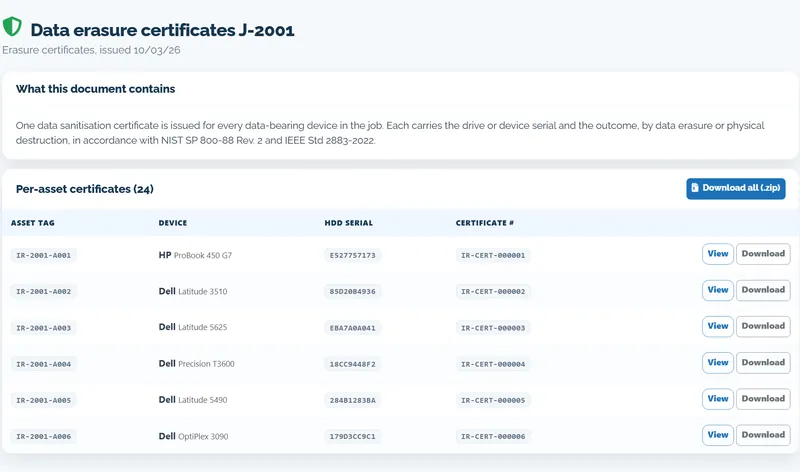
Every drive, certificated
In your Innovent client portal each job lists a data sanitisation certificate for every drive, by asset tag and serial, and you can download them all as one zip.
Illustrative example from the Innovent demo client portal
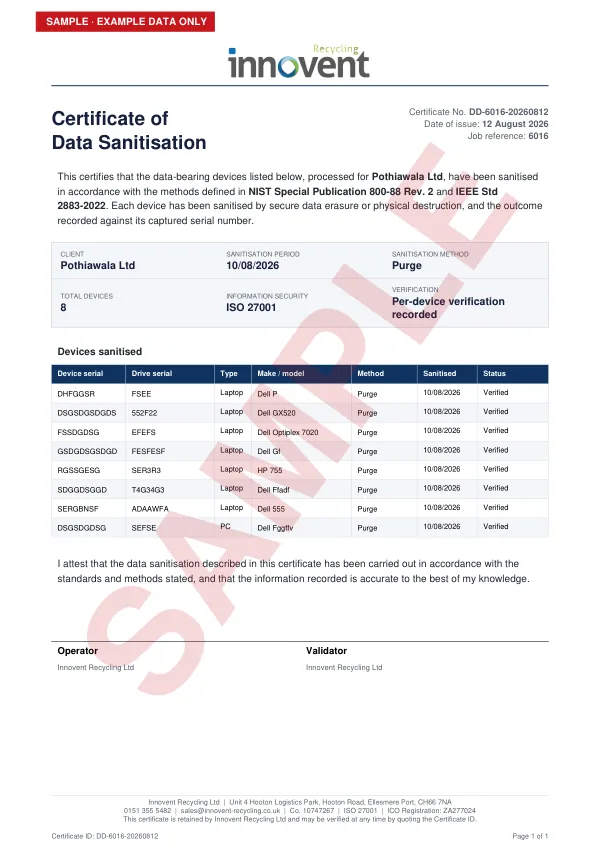
SAMPLE CERTIFICATESee what you receiveA Certificate of Data Sanitisation for one job: serial-matched, one row per device, with the method and date for each device. Sample with example data. See the sample certificates →
Physical Destruction
Drives that fail verification, are physically damaged, or must be destroyed under your policy are physically destroyed, and hard drives can be crushed at your premises. The UK reference for this is the NCSC guidance on sanitising storage media. We destroy all data-bearing media, including hard drives and SSDs:
Hard disk drives (HDD): platters, read/write heads and electronics
Solid state drives (SSD): Flash memory chips and controllers physically destroyed
Mobile devices: smartphones, tablets and USB drives
Magnetic tape: Backup tapes, DAT cartridges, and LTO media physically destroyed
On-site hard drive crushing allows you to witness destruction in real-time, ideal for financial institutions, government departments, and organisations whose policy requires witnessed destruction.
Under NIST 800-88 Rev 2, physical destruction is not an automatic upgrade over verified erasure. It is one of three methods, chosen by data classification and evidenced either way. Our guide to hard drive shredding versus wiping covers that trade-off.
On-site: Our engineers crush hard drives at your premises while you watch (available to schedule)
Off-site: Secure GPS-tracked collection and destruction at our secure facility
All destroyed materials are recycled in accordance with Environment Agency WEEE regulations, supporting our commitment to environmental responsibility.
04
What Certifications Does Innovent Hold for Data Destruction?
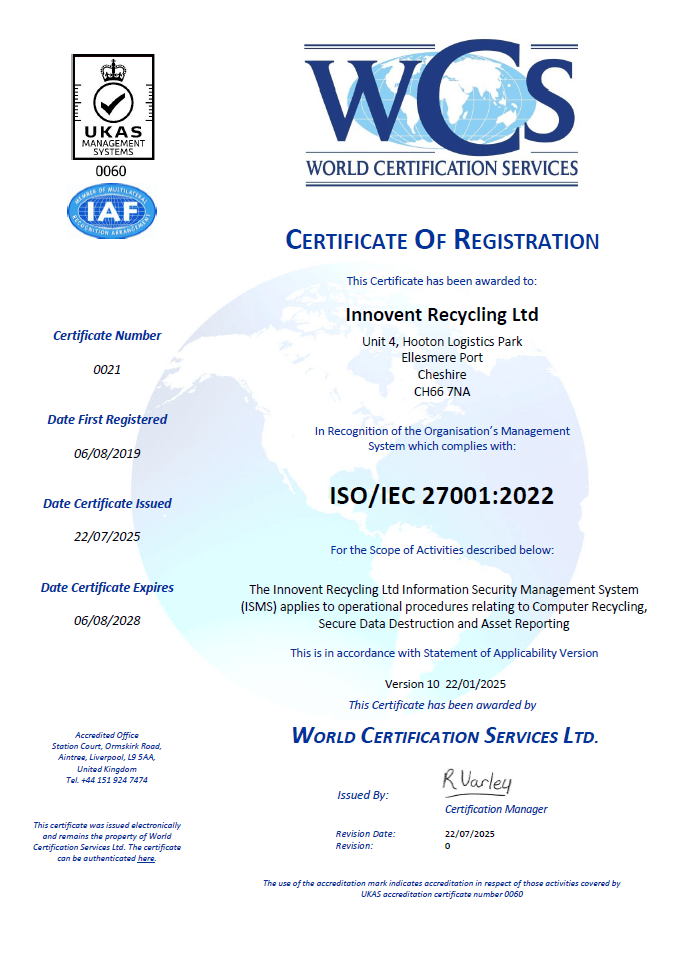
Our ISO/IEC 27001:2022 certificate (certificate number 0021, issued by World Certification Services Ltd, expires 6 August 2028) gives its scope as: "The Innovent Recycling Ltd Information Security Management System (ISMS) applies to operational procedures relating to Computer Recycling, Secure Data Destruction and Asset Reporting". The certificate carries the UKAS accreditation mark 0060. Under it we run:
Systematic risk assessment and treatment processes
Legal Sector: Evidence to support SRA obligations for solicitor practices
Government:Government data erased to NIST SP 800-88 Rev 2 or physically destroyed, with NCSC guidance as the UK reference
Request a collection for secure data destruction with a certificate for every device.
05
Understanding Data Destruction Standards
Data Destruction Methods Comparison
Method
NIST 800-88 Rev 2 method
Best For
Verified erasure
Clear (HDD) or purge (SSD), verified
Resale/Reuse
Physical shredding or crushing
Destroy
Failed or damaged drives, or where policy requires it
NIST 800-88 Rev 2 and the UK's NCSC guidance
NIST SP 800-88 Rev 2 became final on 26 September 2025 and withdrew Revision 1. It is US federal guidance, not UK law, but it is the standard most often named in UK data destruction certificates and tenders. Revision 2 drops the old per-media technique tables, states that multi-pass overwriting is unnecessary, reclassifies degaussing as a purge technique, and asks organisations to verify each sanitisation and then validate it against the sensitivity of the data.
Who can destroy hard drives on site at my office in the UK?
Innovent Recycling crushes hard drives at your premises, so the drives are destroyed before they leave your building. On-site crushing is priced per job: ask us for a quote. If we collect instead, drives are erased at our Hooton facility to NIST SP 800-88 Rev 2 and IEEE Std 2883-2022 and verified, and any drive that fails or must be destroyed is shredded. Every data-bearing device gets a serial-matched certificate of data destruction.
How much does secure data destruction cost?
Our secure data destruction service is included free with our computer recycling service for most organisations. We offer free nationwide collection for bulk IT disposals (10+ laptops, PCs or servers), with data destruction and certificates provided at no additional charge. For small quantities or on-site hard drive crushing requirements, please contact us for a custom quote. Our pricing is transparent with no hidden fees.
What certificate do you provide after data destruction?
We provide serial-numbered Certificates of Data Destruction for every device processed. Each certificate lists the device type, serial number, method applied (verified erasure to NIST 800-88 Rev 2, physical destruction, or on-site crushing), date, and our certification details. These certificates provide audit-ready evidence for GDPR accountability, ICO enquiries, ISO 27001 audits and sector-specific regulatory reviews, and they are the per-device verification record that NIST 800-88 Rev 2 expects you to validate.
What should a certificate of data destruction show?
Every device's serial number, the method used and the date, and it should match what you sent. The ICO expects you to check this. See our certificate of data destruction template.
Is data recoverable after secure deletion?
Not with the methods we use. Erasure follows NIST SP 800-88 Rev 2 and NCSC guidance: a single verified overwrite pass for hard drives, or the drive's built-in sanitise command for SSDs, with every drive verified and any failure physically destroyed. NIST Revision 2 states that one verified pass is enough on modern drives; extra passes add almost no protection.
What's the difference between on-site and off-site data destruction?
On-site destruction involves our engineers crushing hard drives at your premises in front of you, so you can watch it happen. This is ideal for highly sensitive environments like banks or government departments requiring witnessed destruction. Off-site destruction means devices are collected by our GPS-tracked vehicles and processed at our secure facility with certificates issued afterwards. Both come with the same serial-matched certificate; the choice depends on your security policy.
Do you destroy SSDs differently than hard drives?
Yes. SSDs store data in flash memory with spare areas that overwriting cannot reach, and degaussing has no effect on them. For SSDs being reused, we use the drive's built-in sanitise or ATA Secure Erase command, a purge method under NIST SP 800-88 Rev 2, followed by verification. SSDs that fail verification, are damaged, or must be destroyed under your policy are physically destroyed. Hard drives get a single verified overwrite pass, or are physically destroyed if they fail verification.
How long does the data destruction process take?
Wiping time depends on drive capacity and is carried out at our facility after collection. For on-site services, our engineers crush drives individually at your premises while you witness the destruction. We offer nationwide collection with flexible scheduling, with certificates issued once destruction is complete.
What types of devices can you destroy?
We securely destroy all data-bearing devices: desktop and laptop hard drives, SSDs, mobile phones and tablets, USB drives and memory cards, magnetic backup tapes (DAT, LTO), server drives and RAID arrays, chip & PIN card readers, and optical media (CDs, DVDs). We also offer secure document shredding. View our complete list of accepted IT equipment or contact us for specific device enquiries.
Are you GDPR compliant for data destruction?
We act as your data processor under UK GDPR Article 28, with a written Data Processing Agreement. Article 32 requires security "appropriate to the risk", and you stay responsible for the data until it is destroyed. Our serial-matched certificates, issued under our ISO 27001-certified ISMS, help you show how personal data on disposed equipment was destroyed.
What happens to devices after data destruction?
After data destruction, all materials are responsibly recycled in accordance with WEEE Directive requirements. Hard drive metals (aluminium, steel) are separated and sent to metal recyclers. Circuit boards are processed to recover precious metals. Plastics are recycled where possible. We maintain a zero landfill policy—nothing goes to waste. You receive a detailed asset report showing the environmental impact of your recycling, including CO2 savings and materials recovered.
Can I get urgent data destruction?
We offer nationwide collection with flexible scheduling via our nationwide service. If you require urgent destruction, on-site hard drive crushing at your premises can be arranged. Contact us with your location and timeline, and we'll accommodate your requirements wherever possible. Emergency out-of-hours services can be arranged for critical situations.
Do I get an online record of my collection?
Yes. Every client gets a secure Innovent client portal with each job, every device we collected, the data sanitisation certificate for each data-bearing device and the waste transfer note, ready to download. You can also request your next collection there. See how it works on our client portal page.
Book Your Secure Data Destruction Service Today
Protect your organisation from data breaches and help meet your UK GDPR obligations with Innovent Recycling's secure data destruction services. We offer free nationwide collection for 10 or more laptops, PCs or servers, verified erasure or physical destruction, and a certificate for every device.
Whether you need witnessed on-site hard drive crushing or off-site processing, our team, working under our ISO 27001-certified ISMS, ensures your data is erased to NIST 800-88 Rev 2 and verified, or physically destroyed.
Why wait? Old drives in a cupboard are still live data. Secure your data disposal today.
By default we erase every drive to NIST SP 800-88 Rev 2 and verify it, so the hardware can be reused. Drives that fail verification, or that your policy says must be destroyed, are shredded at our Hooton facility. Hard drives can also be crushed at your premises. You get a serial-matched certificate of data destruction for every device, under our ISO 27001:2022-certified ISMS.