
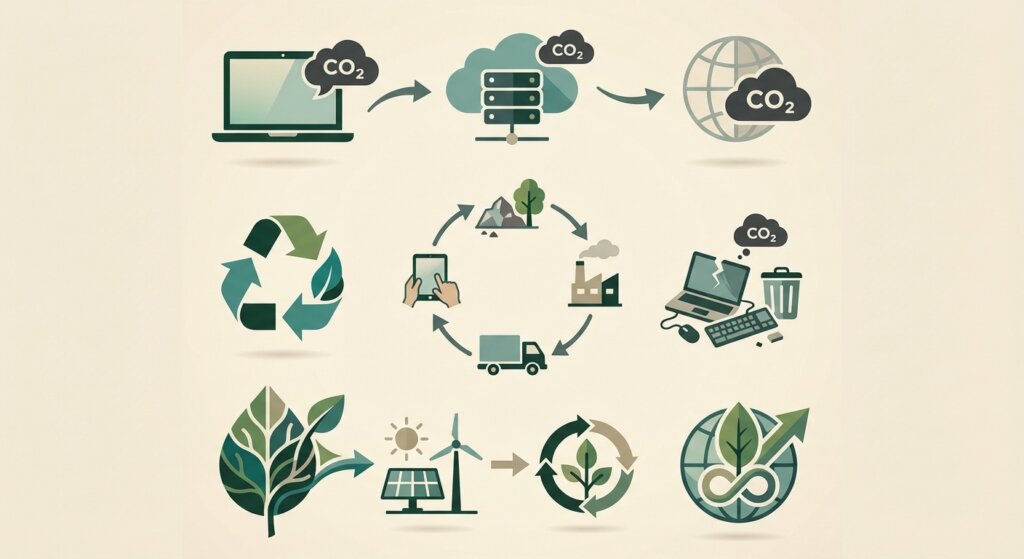
Is Your IT Equipment Hidden in Your Carbon Footprint?
Most UK businesses are focused on reducing energy bills, switching to renewables, and cutting travel emissions. Yet the laptops, servers, and monitors sitting on every desk represent a significant carbon liability that rarely appears on any sustainability dashboard.
For finance directors, ESG leads, and sustainability managers navigating the UK's evolving sustainability reporting landscape, understanding the carbon footprint of IT equipment is no longer optional. The UK Sustainability Reporting Standards (UK SRS), finalised in February 2026, will make Scope 3 emissions reporting mandatory for listed companies from 2027 — and Scope 3 includes every piece of IT hardware your business buys, operates, and disposes of.
This guide explains the carbon mechanics of IT equipment, what UK Scope 3 obligations mean in practice, and how certified recycling and refurbishment can generate measurable reductions in your reported emissions.
80–85%
of a laptop's total carbon footprint is created during manufacturing — before it ever reaches your desk
Embodied Carbon vs Operational Carbon: Why Manufacturing Is the Problem
When people think about the carbon footprint of technology, they tend to focus on electricity consumption — the energy used to charge a laptop or run a server. This is called operational carbon. It matters, but it is only a fraction of the full picture.
Embodied carbon — also called embedded carbon — is the CO2e emitted during the extraction of raw materials, component manufacturing, assembly, and global shipping of the device. For a standard business laptop, embodied carbon accounts for 80–85% of its total lifecycle emissions. For a smartphone, that figure climbs even higher.
Apple's own lifecycle assessments put the manufacturing carbon footprint of a 14-inch MacBook Pro at approximately 185 kg CO2e. The annual operational carbon from charging and use adds around 14 kg CO2e per year. This means that every time your business replaces a working laptop on a standard three-year refresh cycle, it effectively writes off the largest carbon liability associated with that device.
The Refresh Cycle Problem
An organisation with 500 laptops on a three-year refresh cycle replaces approximately 167 devices per year. At 185 kg CO2e per laptop (manufacturing), that cycle generates around 31 tonnes of embodied carbon per year — just from procurement decisions, before a single kilowatt-hour of electricity is consumed.
Extending the lifecycle of those same devices to six years nearly halves the annualised embodied carbon: roughly 15 tonnes per year from the same fleet. That is a reduction of over 40 kg CO2e per device per year — a credible, documentable Scope 3 reduction available to any organisation willing to extend device life rather than default-replace on a fixed schedule.
UK SRS and Scope 3 Obligations: What Businesses Need to Know in 2026
The Financial Reporting Council finalised the UK Sustainability Reporting Standards (UK SRS) in February 2026, aligning the UK with the International Sustainability Standards Board (ISSB) framework. Under IFRS S2 (Climate-related Disclosures), which the UK SRS incorporates, companies must report on all three scopes of greenhouse gas emissions.
The Three Scopes Explained
- Scope 1: Direct emissions from owned or controlled sources (e.g. company vehicles, on-site combustion)
- Scope 2: Indirect emissions from purchased electricity and heat
- Scope 3: All other indirect emissions in the value chain — including purchased goods and services, capital goods, and waste generated in operations
IT hardware falls squarely under Scope 3 Category 1 (Purchased Goods and Services) and Category 11 (Use of Sold Products, if you are a reseller). For most office-based organisations, IT equipment procurement is one of the top three Scope 3 emission sources alongside business travel and supply chain goods.
UK SRS Timeline
The UK SRS framework is expected to be mandatory for UK-listed companies and large financial institutions from financial years beginning on or after 1 January 2027. Premium-listed companies are likely to face earlier application. Voluntary adoption is encouraged in 2026. Non-listed large companies should prepare now — mandatory scope will likely broaden over time.
Critically, reporting obligations require not just disclosing emissions but demonstrating credible transition plans for reducing them. Organisations that cannot demonstrate measurable Scope 3 reduction strategies — including IT procurement and disposal — risk scrutiny from auditors, investors, and regulators.
Lifecycle Extension vs Replacement: The Carbon Comparison
The most powerful Scope 3 lever available to any organisation is extending the useful life of IT equipment. The data is unambiguous.
| Scenario | Annualised CO2e per Device | Fleet of 500 (annual) |
|---|---|---|
| 3-year refresh cycle (new hardware) | ~62 kg CO2e | ~31 tonnes |
| 6-year lifecycle (extended use) | ~31 kg CO2e | ~15.5 tonnes |
| Refurbished laptop (replacing new purchase) | ~3.9 kg CO2e | ~1.95 tonnes |
| Carbon saving: refurb vs new | ~93.7% reduction | ~29 tonnes saved |
Certified remanufactured laptops — properly refurbished, data-wiped, and quality-graded business hardware — represent just 6.34% of the CO2e of a brand-new equivalent device. That is a Scope 3 reduction of over 93% per device, attributable directly to your procurement decision and fully documentable for ESG reporting purposes.
If your organisation is already working with a refurbished hardware supplier, this represents one of the most straightforward Scope 3 wins available. Bluecybercow supplies business-grade refurbished laptops and workstations — each with a full 12-month warranty — providing both the hardware quality assurance and the carbon benefit documentation that ESG reporting requires.
Pro Tip
When purchasing refurbished hardware for ESG reporting purposes, request a product carbon certificate or lifecycle assessment data from your supplier. This documentation supports your Scope 3 Category 1 calculation and demonstrates good-faith emissions reduction in your sustainability report.
Certified WEEE Recycling as a Measurable Scope 3 Reduction
When IT equipment genuinely reaches the end of its serviceable life, responsible disposal through a certified WEEE recycler generates measurable environmental benefits — and critically, generates the documentation needed to support Scope 3 Category 11 (End-of-Life Treatment of Sold Products) and Category 12 (Waste Generated in Operations) reporting.
Certified WEEE recycling under the UK's Waste Electrical and Electronic Equipment regulations ensures:
- Materials recovery: Precious metals, copper, and rare earth elements are recovered rather than landfilled, avoiding the need for virgin material extraction
- Hazardous substance management: Lead, mercury, and cadmium are handled and processed safely, preventing environmental contamination
- Circular economy contribution: Recovered materials re-enter the supply chain, reducing overall manufacturing carbon for future devices
- Audit-ready documentation: WEEE transfer notes, waste consignment notes, and recycling certificates provide the paper trail required for ESG audits
For organisations subject to WEEE producer obligations — any business that places electrical equipment on the UK market — certified recycling is also a legal compliance matter, not solely an ESG consideration. You can view our full range of what we collect including all IT equipment categories.
If your surplus or end-of-life IT equipment still has residual value, IT asset buyback should be your first option: selling working hardware into the secondary market extends device lifecycles and directly reduces your Scope 3 Category 12 reporting burden, while returning cash to offset new equipment costs. Innovent provides full carbon savings documentation — per-device CO₂e estimates and chain-of-custody records — suitable for inclusion in your UK SRS S2 or ESG report.
ISO 27001 and Environmental Compliance: The Dual Benefit
IT disposal decisions carry two compliance risks simultaneously: environmental and data security. Many organisations focus heavily on data destruction — and rightly so — while treating the environmental element as secondary. In the era of Scope 3 reporting, both must be managed with equal rigour.
ISO 27001 certification in an IT recycler ensures that secure data destruction processes meet the internationally recognised standard for information security management. This matters for Scope 3 reporting because it eliminates a false choice: organisations no longer have to choose between secure data disposal and environmentally responsible disposal.
A recycler operating under ISO 27001, with an Environment Agency T11 exemption and a valid Waste Carrier Licence, delivers both assurances simultaneously:
- ISO 27001: Data destruction to HMG Infosec Standard 5, with certificates of destruction for each data-bearing device — satisfying GDPR, DPA 2018, and audit requirements
- T11 Exemption: Environment Agency-registered waste treatment, ensuring legal compliance with WEEE regulations and demonstrable environmental standards
- Waste Carrier Licence: Upper-tier registration confirming the recycler is authorised to transport and process controlled waste
For your ESG report and sustainability documentation, this combination of credentials provides auditable evidence that IT disposal decisions were made responsibly across both dimensions. Check our UK IT recycling statistics to understand the scale of the WEEE challenge and why certified disposal matters at an industry level.
How to Document IT Disposal for ESG and Sustainability Reports
Scope 3 reporting requires more than good intentions — it requires verifiable data. Here is a practical framework for documenting IT equipment carbon across the asset lifecycle.
Step 1: Asset Tracking and Carbon Baseline
Maintain a complete IT asset register with manufacturer, model, purchase date, and quantity. Use manufacturer lifecycle assessment (LCA) data — available for most major brands — to calculate Scope 3 Category 1 emissions at the point of purchase.
Step 2: Lifecycle Extension Records
Document every device that is extended beyond its original refresh target. The avoided carbon from not purchasing replacement hardware is calculable and reportable as an emissions reduction under GHG Protocol Scope 3 guidelines.
Step 3: Certified Disposal Documentation
When assets are disposed of, collect and retain:
- WEEE transfer notes (required by law for all WEEE collections)
- Waste consignment notes (for hazardous WEEE)
- Certificates of data destruction (per device or per batch)
- Recycler's waste carrier licence and exemption details
- Itemised collection reports showing quantities by device type
Step 4: Annual Scope 3 Calculation
Using your asset register, procurement data, and disposal records, calculate total Scope 3 Category 1 and Category 12 emissions for the reporting period. Year-on-year comparisons demonstrating reductions through lifecycle extension and certified disposal form the core of a credible IT sustainability narrative.
For organisations looking to build a full ESG framework around their IT operations — covering governance audit trails, social value from device donation, and a practical partner selection checklist — see our companion guide: ITAD and ESG: How Secure IT Disposal Supports Your Sustainability Targets.
Key Takeaways
- Manufacturing dominates IT carbon: 80–85% of a laptop's total lifecycle carbon is created during manufacturing — making procurement and lifecycle decisions the primary lever for Scope 3 reduction.
- UK SRS Scope 3 is coming: The UK SRS framework, finalised February 2026, mandates Scope 3 reporting for listed companies from 2027. IT equipment is firmly within Scope 3 Category 1.
- Lifecycle extension saves 40+ kg CO2e per device: Extending a laptop from three to six years of service nearly halves the annualised embodied carbon — a straightforward, documentable reduction.
- Refurbished hardware is the most impactful procurement decision: Certified remanufactured laptops represent just 6.34% of the CO2e of new equivalents — a Scope 3 reduction exceeding 93%.
- Certified WEEE recycling generates audit-ready documentation: Proper disposal through an ISO 27001-certified, T11-exempt recycler delivers both environmental compliance and the documentation trail required for ESG audits.
- Data security and environmental compliance are not a trade-off: The right recycler handles both simultaneously, providing certificates of destruction alongside full WEEE compliance paperwork.
Frequently Asked Questions
What is the difference between Scope 2 and Scope 3 emissions for IT equipment?
Scope 2 covers the electricity your IT equipment consumes while in operation — this appears on your electricity bill and is relatively easy to measure. Scope 3 covers the far larger manufacturing carbon embedded in the hardware itself (Category 1: Purchased Goods), as well as waste from disposal (Category 12). For most organisations, IT-related Scope 3 emissions significantly exceed Scope 2 IT emissions.
Is Scope 3 reporting mandatory for UK businesses in 2026?
The UK SRS framework was finalised in February 2026 and is expected to be mandatory for UK-listed companies and large financial institutions from financial years beginning on or after 1 January 2027. In 2026, voluntary adoption is encouraged. Non-listed large companies should prepare their data collection processes now, as the scope of mandatory reporting is expected to broaden over time.
How do I calculate the carbon footprint of my organisation's IT equipment?
Start with your IT asset register — manufacturer, model, purchase date, and quantity. Most major manufacturers (Apple, Dell, Lenovo, HP) publish lifecycle assessment data for their devices, showing total carbon footprint per unit. Multiply device count by the published figure, annualise over the device lifecycle, and report the resulting number under Scope 3 Category 1. For disposed assets, calculate end-of-life emissions using WEEE transfer documentation.
Does IT equipment recycling actually reduce my Scope 3 emissions?
Responsible recycling reduces Scope 3 Category 12 emissions (waste generated in operations) by diverting equipment from landfill and recovering materials for reuse. It also contributes to the broader circular economy, reducing demand for virgin materials. While recycling alone does not eliminate the embodied carbon already emitted during manufacturing, lifecycle extension combined with certified recycling is the most impactful overall strategy for reducing IT-related Scope 3 emissions year-on-year.
What documentation do I need for an ESG audit of IT disposal?
For a credible ESG audit you will need: WEEE transfer notes for all equipment collected, certificates of data destruction per device or batch, your recycler's waste carrier licence number and Environment Agency exemption details, itemised collection reports showing quantities by device type, and annual summaries of total WEEE volume processed. Innovent provides all of this documentation as standard with every collection.
How much carbon is saved by using refurbished laptops instead of new ones?
Certified remanufactured laptops generate approximately 6.34% of the carbon footprint of an equivalent new device — meaning each refurbished laptop purchase avoids over 93% of the manufacturing carbon that would otherwise be emitted. For an organisation refreshing 100 laptops annually, switching from new to certified refurbished hardware could avoid well over 17 tonnes of CO2e per year from procurement decisions alone.
What certifications should I look for in an IT recycler for ESG compliance?
For ESG and WEEE compliance, verify that your recycler holds: an upper-tier Waste Carrier Licence (Environment Agency registered), an appropriate Environment Agency waste exemption or permit (such as T11), and ISO 27001 certification if secure data destruction is required. These credentials confirm both environmental and data security compliance — a requirement for organisations managing personal or sensitive data on end-of-life assets. You can verify our secure data destruction credentials and accreditations on our website.
Can extending IT equipment lifecycles genuinely reduce our carbon report figures?
Yes — and this is arguably the most impactful intervention available to most organisations. Extending a device's life from three to six years nearly halves the annualised manufacturing carbon attributed to your Scope 3 Category 1 in each reporting period. The avoided purchase of a new device can be calculated and reported as an emissions reduction under GHG Protocol Scope 3 guidelines, providing a credible, documented contribution to your organisation's decarbonisation trajectory.
Found this guide helpful? Share it!
Help other businesses navigate Scope 3 IT emissions reporting



About Innovent Recycling
Innovent Recycling is a UK-based specialist in secure IT asset disposal and recycling. With ISO 27001 certification and Environment Agency T11 exemption, we provide comprehensive, compliant recycling solutions for businesses across the United Kingdom — complete with the documentation required for ESG and sustainability reporting.
Our services include:
- IT Equipment Recycling - Secure, compliant disposal of all business IT assets with full WEEE documentation
- Certified Data Destruction - HMG Infosec Standard 5 compliant wiping and shredding with certificates per device
- Full Equipment Range - Laptops, servers, monitors, mobile devices, networking equipment and more
- Nationwide Collections - Free collection service available UK-wide, with itemised collection reports
Trusted by UK businesses for secure, compliant IT disposal with full ESG documentation. View our accreditations and certifications.
Ready to Document Your IT Disposal for ESG Reporting?
Get a free quote for ISO 27001-certified IT recycling with full WEEE documentation, certificates of destruction, and the audit trail your Scope 3 report requires.
Or call us on 0151 355 5482