
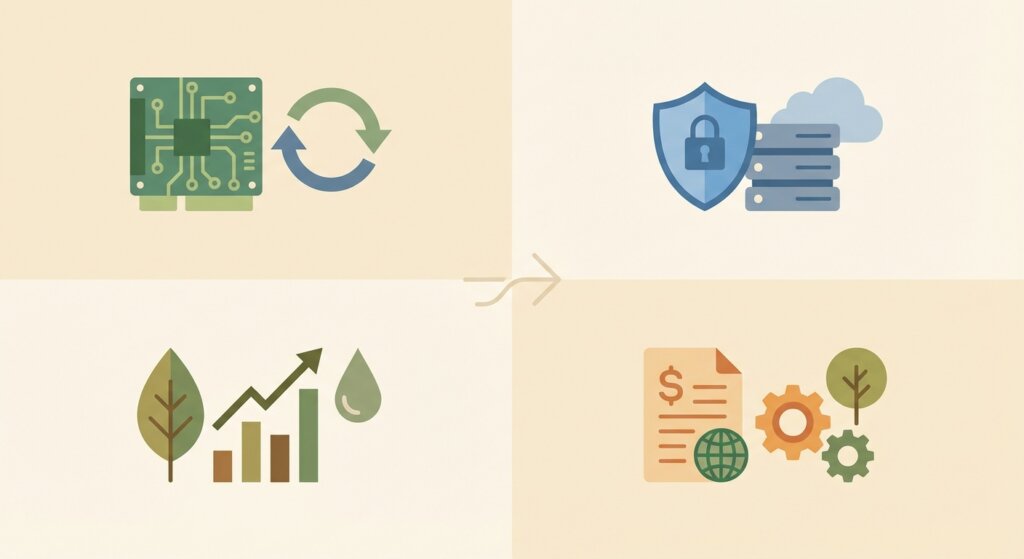
Is Your IT Disposal Strategy Ready for ESG Scrutiny?
Environmental, Social and Governance (ESG) reporting has moved from a voluntary differentiator to a boardroom imperative. With the UK Sustainability Reporting Standards (UK SRS) finalised in February 2026 and mandatory for listed companies from 2027, finance directors and sustainability managers are scrutinising every operational area for measurable environmental impact — including, increasingly, the IT department.
Yet IT Asset Disposal (ITAD) remains a blind spot in many corporate ESG strategies. Organisations that rigorously measure Scope 1 and Scope 2 emissions frequently overlook the carbon, governance, and social value implications of retiring their IT hardware. That oversight is becoming harder to justify — and, under forthcoming reporting mandates, potentially costly.
This guide sets out how an ESG-aligned ITAD policy works in practice: from quantifying carbon savings and embedding governance audit trails, to maximising social value through device donation. It also includes a practical checklist for CIOs and sustainability managers evaluating ITAD partners.
2027
UK Sustainability Reporting Standards become mandatory for listed companies — IT disposal sits squarely within Scope 3 Category 12 reporting obligations
UK SRS 2027: Why IT Disposal Is Now a Mandatory Reporting Area
The UK Sustainability Reporting Standards, finalised by the UK Government in February 2026, align closely with the International Sustainability Standards Board (ISSB) framework. For listed companies, disclosure of climate-related financial risks and emissions across all three Scopes becomes mandatory for financial years starting on or after 1 January 2027.
Under the Greenhouse Gas Protocol — the methodology underpinning UK SRS — end-of-life treatment of sold or disposed products falls under Scope 3 Category 12: End-of-Life Treatment of Sold Products. For IT departments, this means the environmental footprint of retired hardware is no longer an informal consideration: it must be measured, reported, and reduced.
For organisations outside the listed company threshold today, the direction of travel is clear. UK SRS is expected to cascade to large private companies, and institutional investors, procurement frameworks, and supply chain ESG questionnaires are already applying equivalent standards regardless of statutory obligation.
Compliance Alert: Scope 3 Cannot Be Ignored
Under UK SRS, Scope 3 emissions are not optional disclosures — they are required where material. For many organisations with large IT estates, end-of-life hardware disposal represents a significant and measurable Scope 3 Category 12 source. An ITAD partner who cannot provide the data you need to report is a compliance liability, not just an operational inconvenience.
Scope 3 Calculation Framework: Quantifying Your ITAD Carbon Savings
One of the most common frustrations sustainability managers face is the absence of meaningful data from ITAD providers. To include IT disposal in your Scope 3 reporting, you need quantified carbon figures — not just a certificate of recycling. The framework below gives you a practical starting point.
Step 1: Baseline Your IT Estate
Before calculating savings, establish what you are disposing of. A typical annual hardware retirement for a mid-sized UK organisation (500-2,000 employees) might include:
- Laptops and desktop computers
- Servers and networking equipment
- Monitors and peripherals
- Mobile devices and tablets
Step 2: Apply Embodied Carbon Figures
Manufacturing new IT equipment is carbon-intensive. The embodied carbon of a typical business laptop sits between 300–400 kg CO₂e (manufacture to delivery). When refurbished equipment displaces new production, those emissions are avoided. Use these reference figures as a starting basis:
- Laptop / notebook: ~330 kg CO₂e embodied carbon (manufacture)
- Desktop PC: ~400 kg CO₂e embodied carbon
- Server (1U rack): ~900–1,200 kg CO₂e embodied carbon
- Monitor (24"): ~500 kg CO₂e embodied carbon
Step 3: Calculate Avoidance from Refurbishment and Reuse
When your retired devices are refurbished and resold — rather than shredded — the carbon embodied in those devices avoids being expended again in new manufacture. The calculation is straightforward:
Scope 3 Carbon Avoidance Calculation
Step A: Devices refurbished and reused × embodied carbon per device type
Step B: Multiply by reuse credit factor (typically 0.5–0.85 depending on asset age and methodology)
Step C: Add transport and processing emissions (from ITAD provider's data)
Net Carbon Saving = Step A × Step B − Step C
Example: An organisation retires 200 laptops annually. If 160 are graded for refurbishment and resale, and the embodied carbon per laptop is 330 kg CO₂e with a 0.7 reuse credit factor, the net avoidance is approximately 36.96 tonnes CO₂e — a meaningful figure for a Scope 3 disclosure. For the full carbon methodology behind IT equipment disposal, see our IT Equipment Carbon Footprint: Scope 3 Guide.
Pro Tip: Request Carbon Data from Your ITAD Partner
Ask your ITAD provider to supply a per-disposal carbon report — ideally broken down by device type, refurbishment rate, and materials recovered. This data feeds directly into your Scope 3 Category 12 disclosure and removes the need to estimate using secondary sources.
The Governance Pillar: Audit Trails and Certificates of Destruction as ESG Evidence
ESG is not just E — the G (Governance) pillar carries equal weight in institutional investor assessments, supply chain audits, and public sector procurement frameworks. In the context of IT disposal, governance translates to a demonstrable, documented chain of custody for every device that leaves your organisation.
A robust ITAD governance framework produces three categories of documentation that satisfy both ESG auditors and data protection regulators:
- Certificate of Data Destruction — Confirms each device's data has been wiped to an approved standard (NCSC-aligned, HMG Infosec Standard 5, or physical destruction). Under GDPR, this is your evidence of personal data erasure obligations met. Under UK SRS governance disclosures, it demonstrates information security processes are embedded into asset lifecycle management.
- Collection Receipt and Asset Report — A signed collection record of what was collected on the day, followed by a serialised asset report covering every device once reconciled at the processing facility — confirming the chain of custody from your premises onwards. This prevents devices appearing in secondary markets with your organisation's data intact — a governance failure with both regulatory and reputational consequences.
- WEEE Compliance Certificate — Confirms waste electrical and electronic equipment has been processed by a registered carrier in compliance with the Waste Electrical and Electronic Equipment Regulations 2013 (as amended). For Scope 3 reporting, this confirms the environmental disposal pathway and supports third-party verification of your claims.
Innovent Recycling issues serialised certificates of data destruction for every disposal, with an auditable record matched to individual asset serial numbers. This documentation pack is the evidence base your ESG auditor needs — not a generic recycling statement.
"Governance in ITAD is not a box-ticking exercise — it is the documentary evidence that your organisation controls its data to the point of final destruction."
Social Value: Device Donation and Bridging the Digital Divide
The S in ESG — social value — is where ITAD has a genuinely differentiated story to tell. While environmental metrics dominate sustainability reporting, social value is gaining prominence in procurement criteria, investor assessments, and public sector requirements under the Social Value Act.
Device donation programmes redirect securely wiped IT equipment to charities, community organisations, schools, and digital inclusion initiatives — rather than processing it entirely for materials recovery. The social impact is tangible and reportable:
- Digital inclusion: Donated devices reach individuals and families without access to reliable computing — directly addressing the UK's digital divide, which affects an estimated 7.5 million adults according to Ofcom
- Education support: Refurbished laptops and tablets channelled to schools and further education providers extend the life of equipment and support curriculum delivery
- Third-sector capacity: Charities and community organisations operating on constrained budgets gain access to functional IT equipment that would otherwise be beyond their procurement reach
For ESG reporting purposes, device donation generates a quantifiable social value metric: number of devices donated, recipient organisations, and estimated beneficiaries reached. This data feeds directly into the S pillar of your ESG disclosure and can be presented as a standalone social impact figure in annual reports.
It also creates a compelling internal narrative: rather than your retired IT equipment becoming landfill, it becomes community infrastructure.
WEEE and ISO 27001: Your ESG Compliance Proof Points
When sustainability teams evaluate ITAD partners, two credentials carry particular weight as ESG compliance evidence: WEEE compliance certification and ISO 27001 accreditation. Understanding what each demonstrates — and what questions to ask — prevents greenwashing claims from passing unchallenged.
WEEE Compliance
The UK Waste Electrical and Electronic Equipment Regulations require that WEEE is collected and processed by registered carriers and treated at approved facilities. For ESG purposes, WEEE compliance means:
- Your organisation's legal duty of care is discharged under the Environmental Protection Act 1990
- Materials are recovered to legally required standards, preventing hazardous components (lead, cadmium, mercury) from entering landfill
- You receive auditable documentation confirming compliant treatment — a verifiable data point for Scope 3 reporting
Innovent holds an Environment Agency T11 Exemption and an upper-tier Waste Carrier Licence, confirming compliant WEEE processing and transport. Our WEEE recycling service provides full documentation for every disposal.
ISO 27001 Accreditation
ISO 27001 is the international standard for information security management. In the context of ITAD, it confirms that data destruction processes, staff training, physical security, and chain of custody controls meet a certified standard — independently audited and renewed annually.
For ESG governance disclosures, ISO 27001 certification from your ITAD provider serves as third-party assurance that your organisation's data lifecycle management — including end-of-life — meets an internationally recognised security standard. This is especially relevant for organisations subject to UK GDPR, FCA operational resilience rules, and sector-specific compliance frameworks such as NHS DSP Toolkit or Cyber Essentials Plus.
What an ESG-Aligned ITAD Policy Looks Like in Practice
A professional services firm with 1,200 employees across three UK offices retires approximately 300 devices per year. Prior to adopting an ESG-aligned ITAD policy, their process was informal: devices were collected by an unknown third party, no data destruction certificates were issued, and no carbon or social value data was captured.
Following a sustainability audit ahead of a major public sector contract tender — which required demonstrable ESG credentials — the firm restructured their ITAD approach around four pillars:
- Certified partner selection: Engaged an ISO 27001-certified ITAD provider with a waste carrier licence and WEEE compliance documentation capability
- Serialised audit trail: Every data-bearing device collected is logged by serial number, with a certificate of data destruction issued within five working days
- Carbon reporting: The ITAD provider supplies an annual carbon impact report broken down by device type, refurbishment rate, and weight of materials recovered — which feeds directly into the firm's Scope 3 Category 12 disclosure
- Social value programme: Devices graded as suitable for reuse are donated to three registered charities — generating a social value metric of approximately 120 devices per year to community beneficiaries
The outcome: a fully evidenced ITAD contribution to the firm's ESG report, a successful public sector tender submission, and a documented governance process that reduces the risk of regulatory action under UK GDPR.
This is the practical difference between disposing of IT equipment and an ESG-aligned ITAD policy. For a complete guide to the IT asset disposal process, see our best practices guide.
CIO and Sustainability Manager Checklist: Choosing an ESG-Aligned ITAD Partner
When evaluating ITAD providers against your ESG obligations, the following checklist covers the minimum verification points across all three ESG pillars. Use it in supplier questionnaires, tender evaluations, and annual contract reviews.
Environmental (E)
- Does the provider hold an Environment Agency Waste Carrier Licence (upper-tier)?
- Do they operate under an appropriate Environment Agency exemption or permit for WEEE processing?
- Can they provide a per-disposal carbon report for your Scope 3 Category 12 disclosure?
- What is their device refurbishment rate? (Higher = more carbon avoidance)
- Do they provide data on materials recovered by weight and type?
- Can they confirm zero-to-landfill policy with supporting documentation?
Social (S)
- Do they operate a device donation programme with registered charities?
- Can they provide a social value report quantifying devices donated and beneficiaries reached?
- Do they demonstrate fair employment practices (Living Wage, workforce diversity)?
- Are they a UK-based operation (supporting domestic employment and reducing transport emissions)?
Governance (G)
- Are they ISO 27001 certified? (Confirm certificate number and current validity)
- Do they issue serialised certificates of data destruction per device?
- Do they provide a full asset manifest (serial numbers, collection receipt)?
- Is data destruction performed to NCSC-aligned or HMG Infosec Standard 5 standards?
- Can they support third-party ESG audit verification of their documentation?
- Are they registered with the ICO as a data processor where applicable?
Pro Tip: Include ITAD in Your ESG Supplier Questionnaire
Add the checklist questions above to your standard supplier sustainability questionnaire. Requiring ISO 27001, carbon reporting capability, and WEEE compliance documentation as minimum supplier criteria ensures your ITAD partner is ESG-ready before you sign a contract — not after your first audit.
Key Takeaways
- UK SRS mandatory from 2027: Listed companies must report Scope 3 emissions, including end-of-life IT disposal under Category 12. Establishing compliant ITAD processes now avoids a reporting gap at compliance deadline.
- Quantify carbon avoidance: Use the Scope 3 calculation framework to translate refurbishment rates into CO₂e savings for your ESG report — request per-disposal data from your ITAD provider.
- Governance requires documentation: Certificates of data destruction, asset manifests, and WEEE compliance certificates are the evidential backbone of your ITAD governance disclosure. Generic recycling statements are insufficient.
- Social value is measurable: Device donation programmes generate quantifiable social impact metrics — number of devices, recipient organisations, beneficiaries — that directly contribute to your S pillar disclosure.
- ISO 27001 and WEEE compliance are baseline requirements: An ESG-aligned ITAD partner must hold both. They provide third-party-assured governance for data security and environmental treatment.
- Accreditations to check — not assume: Always verify ISO 27001 certificate currency, Environment Agency waste carrier registration, and WEEE processing credentials. Do not rely on supplier self-declaration alone.
Frequently Asked Questions
What is ITAD ESG and why does it matter for UK businesses?
ITAD ESG refers to the integration of IT Asset Disposal practices within a company's Environmental, Social and Governance strategy. It matters because UK Sustainability Reporting Standards, mandatory for listed companies from 2027, require disclosure of Scope 3 emissions — which include end-of-life IT hardware under Category 12. Beyond compliance, ESG-aligned ITAD provides measurable carbon avoidance data, social value metrics from device donation, and governance evidence through certified data destruction audit trails.
How does IT disposal fit into Scope 3 emissions reporting?
Under the Greenhouse Gas Protocol — the standard used for UK SRS compliance — IT disposal falls under Scope 3 Category 12: End-of-Life Treatment of Sold Products. For internal IT assets being retired, the relevant calculation considers the embodied carbon of the hardware and the avoidance generated by refurbishment and reuse versus landfill disposal. Your ITAD provider's carbon report supplies the input data for this calculation.
What documentation do I need from my ITAD provider for ESG reporting?
For a complete ESG documentation pack you need: (1) Serialised certificates of data destruction per device, confirming GDPR compliance and governance; (2) A WEEE compliance certificate confirming regulatory treatment; (3) An asset manifest (serial numbers, collection receipt) for chain of custody evidence; and (4) An annual carbon impact report broken down by device type, refurbishment rate, and materials recovered. This documentation set satisfies Scope 3 Category 12 disclosure requirements and provides evidence for ESG auditors.
What is the UK SRS and when does it become mandatory?
The UK Sustainability Reporting Standards (UK SRS) were finalised by the UK Government in February 2026 and align with the International Sustainability Standards Board (ISSB) framework. Mandatory disclosure of climate-related financial risks and emissions across all three Scopes — including Scope 3 — applies to UK-listed companies for financial years starting on or after 1 January 2027. Large private companies and SMEs supplying listed companies are expected to face equivalent requirements through supply chain ESG questionnaires and procurement criteria before statutory obligations cascade.
Does device donation count towards our ESG social value reporting?
Yes. Device donation programmes generate quantifiable social value metrics that contribute directly to the S pillar of your ESG disclosure. Reportable data includes: number of devices donated, recipient organisations (registered charities, schools, digital inclusion programmes), estimated beneficiaries reached, and the replacement value of devices supplied. Under Social Value Act criteria — which apply to public sector procurement — device donation also satisfies "wellbeing" and "digital inclusion" social value commitments, which can strengthen tender submissions.
Is ISO 27001 certification essential when choosing an ITAD provider for ESG purposes?
ISO 27001 certification is the strongest third-party assurance available for data security governance in ITAD. For ESG purposes, it provides independently verified evidence that your ITAD partner's data destruction processes, chain of custody controls, and information security management meet an internationally recognised standard. This is important for the G pillar of your ESG disclosure — particularly where your organisation is subject to UK GDPR, FCA operational resilience requirements, or public sector information security standards. Always verify the certificate is current and held by the specific processing facility, not just a parent company.
Can IT disposal savings appear in our annual sustainability report?
Yes, provided you have the supporting data. A properly documented ITAD programme can contribute three categories of sustainability report data: (1) Scope 3 Category 12 carbon avoidance figures (in tonnes CO₂e); (2) WEEE compliance evidence (weight of e-waste processed, materials recovered); and (3) Social value metrics from device donation. The key requirement is that your ITAD provider issues a structured carbon and impact report — not merely a certificate of recycling — so that figures are specific to your organisation's disposal activity rather than generic industry averages.
Found this guide helpful? Share it!
Help sustainability and IT teams discover this essential ESG guide



About Innovent Recycling
Innovent Recycling is a UK-based specialist in secure IT asset disposal and recycling. With ISO 27001 certification, Environment Agency T11 exemption, and an upper-tier Waste Carrier Licence, we provide comprehensive, ESG-ready disposal solutions for businesses across the United Kingdom.
Our services include:
- IT Equipment Recycling - Secure, compliant disposal of all business IT assets with full WEEE documentation
- Certified Data Destruction - Serialised certificates of destruction per device for governance audit trails
- WEEE Compliance Management - Full regulatory compliance documentation for ESG Scope 3 reporting
- IT Recycling Services - Secure, compliant IT recycling for all business hardware with full chain of custody
- Carbon Footprint Reporting - Per-disposal carbon impact data for your Scope 3 Category 12 disclosure
Trusted by businesses across the UK for secure, ESG-compliant IT disposal. View our accreditations and certifications.
Ready for ESG-Aligned IT Disposal?
Get a free quote for secure IT asset disposal with full ESG documentation — carbon reports, certificates of destruction, and WEEE compliance certification included.
Or call us on 0151 355 5482