
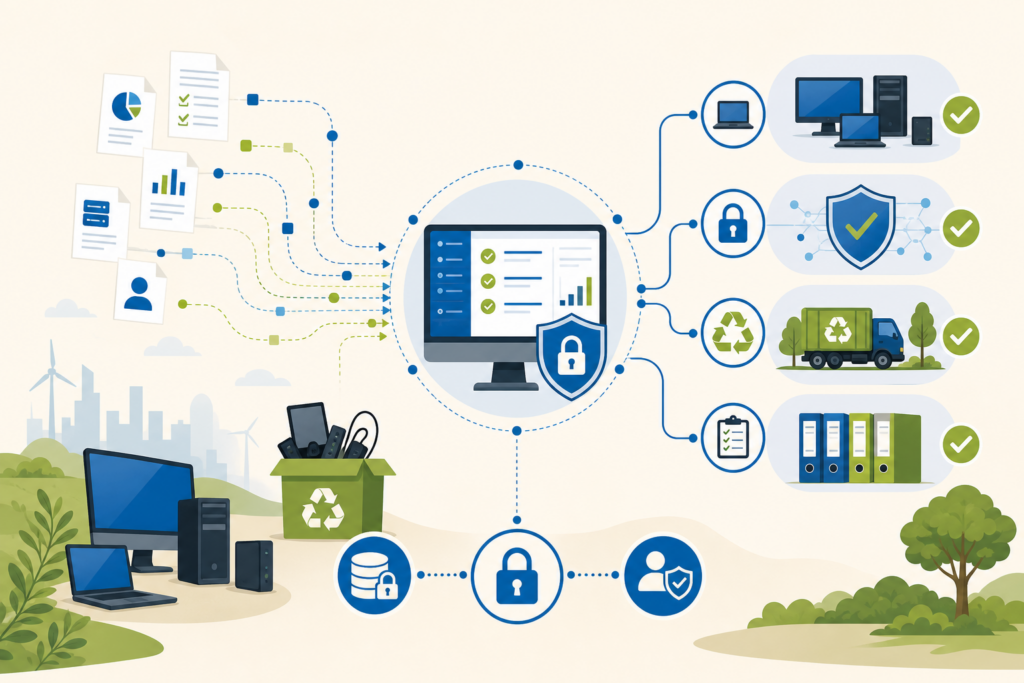
Key facts at a glance
- From October 2026, DEFRA’s Digital Waste Tracking Service replaces paper waste transfer notes in England, Wales and Northern Ireland (Scotland follows January 2027).
- It is a legal requirement under Section 58 of the Environment Act 2021 — not a voluntary upgrade.
- Non-compliance risks fines of up to £5,000 per incident and potential criminal prosecution.
- It applies to any organisation disposing of IT hardware — servers, laptops, mobiles and other equipment.
Is Your Business Ready for the End of Paper Waste Transfer Notes?
From October 2026, the way UK businesses document their IT asset disposal is changing permanently. DEFRA's Digital Waste Tracking Service is replacing paper waste transfer notes with a mandatory electronic system — and if your organisation disposes of servers, laptops, mobile devices, or any other IT hardware, you need to understand what this means for your operations right now.
This is not a voluntary upgrade to how you file paperwork. It is a legal requirement under Section 58 of the Environment Act 2021, and businesses that continue relying on paper records after October 2026 face fines up to £5,000 per incident and potential criminal prosecution.
This guide explains exactly what the new system requires, who it affects, what October 2026 means in practice, and the steps you should be taking now to ensure your IT disposal workflows are compliant before the deadline arrives.
maximum fine per incident for businesses that fail to comply with DEFRA's Digital Waste Tracking requirements from October 2026
What Is DEFRA's Digital Waste Tracking Service?
DEFRA's Digital Waste Tracking Service (DWTS) is a centralised government platform designed to record every movement of controlled waste across England, Wales, and Northern Ireland electronically. Scotland follows in January 2027. Think of it as a real-time audit trail for all waste, replacing the disconnected, paper-based system that has existed for decades.
Under the old system, waste transfer notes (WTNs) were filled in on paper or as PDFs, handed over at point of collection, and filed locally by each business. There was no central record. Regulators could only check compliance through spot inspections, and unscrupulous operators could easily falsify or lose documentation. Fly-tipping and illegal waste disposal cost the UK an estimated £392 million per year to clean up — the DWTS is designed to close the loopholes that allow this to happen.
The new service, launched in public beta on 28 April 2026, requires waste to be logged digitally when it arrives at a licensed receiving site. Each load generates a unique digital record capturing:
- Waste type and quantity - Including the relevant waste code (EWC classification)
- Receiving site details - Permit number, operator name, location
- Transfer parties - Who generated the waste, who transported it, who received it
- Hazardous properties - Required for equipment containing hazardous materials
- Intended treatment - Reuse, recycling, recovery, or disposal
Records must be entered by the end of the second working day after waste is received. The system operates via an API-first model, meaning most licensed waste processors will integrate it with their existing software — but a spreadsheet upload option is available as a temporary measure until at least October 2027 for smaller operators.
Crucially, this does not replace WEEE regulations. It sits alongside them. Your IT equipment still needs to be processed through a WEEE-compliant channel, and now that entire journey must also be recorded on the DWTS.
Who Must Comply: IT Asset Holders and the Duty of Care
Phase 1 of the DWTS (October 2026) mandates compliance for waste receiving sites — the licensed facilities that accept IT equipment for processing, recycling, or disposal. This covers approximately 12,000 waste site operators across England, Wales, and Northern Ireland.
If you are an IT manager, procurement lead, or facilities manager disposing of end-of-life IT assets, you are not directly required to log records in the DWTS from October 2026. But this does not mean you can ignore it.
Your legal obligations under the Environmental Protection Act 1990 duty of care already require you to transfer waste only to authorised carriers and ensure it reaches a legitimate destination. The DWTS makes verification easier — and makes your exposure greater if you hand equipment to a non-compliant handler.
What This Means in Practice
When you arrange collection of old servers, laptops, or network equipment, your IT asset disposal partner — the company collecting and processing the hardware — must be registered on the DWTS and create a digital record for every load they receive. You should be asking them directly:
- Are you registered on the DEFRA Digital Waste Tracking Service?
- Can you provide a digital tracking reference for each waste movement?
- Is your receiving site operating under a valid permit — not just an exemption?
IT hardware covers a wide range: desktops, laptops, servers, storage arrays, networking equipment, mobile devices, monitors, printers, and any peripheral devices. All of it is controlled waste. All of it falls under the DWTS when it arrives at a receiving facility.
Watch Out: Exemption Sites Are Not Phase 1 Mandated
Sites that operate under registered exemptions (rather than full permits) are not mandated in Phase 1. From October 2027 they will be required to join. Until then, verify carefully whether your IT disposal partner holds an actual permit, not just an exemption. A permit-holding facility gives you a cleaner, more auditable paper trail right now.
The October 2026 Deadline: What Actually Changes
The public beta launched on 28 April 2026. From that date, all permitted waste receiving sites in England, Wales, and Northern Ireland have been encouraged to register and start uploading records. When October 2026 arrives, this becomes a legal obligation rather than a voluntary exercise.
Concretely, from October 2026:
- Paper waste transfer notes are no longer legally sufficient for permitted receiving sites — digital records on the DWTS are required
- Hazardous waste consignment notes must also be logged digitally (for relevant waste streams)
- Every load of IT hardware received at a licensed facility must have a digital tracking record created within two working days
- Annex VII forms for green list waste exports will be managed through the system in a subsequent update
The registration fee is £26 per year — an intentionally low barrier to entry. There is no excuse for IT disposal partners to be unregistered when the cost of access is roughly the same as a tank of fuel.
What does not change in October 2026: your existing WEEE compliance obligations. The Waste Electrical and Electronic Equipment regulations remain fully in force. WEEE recycling documentation, including evidence of correct treatment, is still required alongside the DWTS records. These two systems run in parallel — one does not replace the other.
Scotland: January 2027
Scottish businesses have a slightly later mandatory start date of January 2027. However, the Scottish Environment Protection Agency (SEPA) has encouraged early registration, and if you operate UK-wide, aligning your processes to a single October 2026 standard makes practical sense. There is no benefit to running different documentation procedures by region.
How the DWTS Affects Your IT Disposal Workflows
For most businesses, the biggest change is not in what you need to do, but in what your IT asset disposal partner needs to do — and what you need to verify from them.
Before Collection: Verify DWTS Registration
Before October 2026, any business booking an IT asset collection should be confirming that their chosen processor is either already registered on the DWTS (during the voluntary public beta from April 2026) or has committed to a specific registration date before the mandatory deadline. This should be part of your vendor due diligence, sitting alongside verification of their waste carrier licence and data destruction credentials.
At Collection: The Transfer Chain
When your equipment is collected, the chain now looks like this:
- Your IT disposal partner collects the hardware from your site
- Equipment travels to the licensed receiving facility
- Receiving facility logs a digital record on the DWTS within two working days
- The record captures waste type, quantity, EWC codes, and party details
- You should receive a copy of the DWTS tracking reference alongside your existing certificate of data destruction
That final point is worth emphasising. As DWTS records become standard, professional IT asset disposal companies will be issuing DWTS tracking references alongside certificates of data destruction as part of their standard documentation package. If your current provider does not plan to do this, that is a signal worth paying attention to.
For Your Internal Records
Your internal asset disposal register should be updated to include:
- DWTS tracking reference number for each collection
- Name and permit number of the receiving site
- Date of receipt at the facility
- Confirmation that WEEE treatment documentation has also been received
This is not a major administrative burden. Most of this information is already captured when you receive data destruction certificates. It is an extension of existing good practice, not a reinvention of it.
Pro Tip
Update your IT asset disposal policy documents and supplier contracts now — before October 2026 — to include DWTS registration as a mandatory requirement for any vendor handling your waste IT equipment. This gives you contractual leverage if a supplier is slow to comply, and demonstrates proactive governance if you face a regulatory query.
Penalties for Non-Compliance: What Businesses Face
Non-compliance with the Digital Waste Tracking Service carries penalties under the same framework as current waste duty of care offences. The Environment Agency, Natural Resources Wales, and the Northern Ireland Environment Agency are the enforcement bodies.
The Penalty Regime
- Fixed monetary penalties - Up to £5,000 per incident for failing to record waste correctly on the DWTS
- Variable monetary penalties - No maximum cap; calculated by reference to business turnover and the economic benefit gained from non-compliance
- Criminal prosecution - Available under the Environment Act 2021 for persistent or deliberate non-compliance
- Compliance notices - Regulators can issue formal notices requiring corrective action within a specified timeframe
- Permit suspension or revocation - For receiving sites, the ultimate penalty is losing the right to operate
The Environment Agency has stated that initial enforcement will prioritise education and guidance, with formal cautions and prosecution reserved for continued non-compliance. This mirrors how WEEE enforcement began — reasonably light-touch initially, but with a clear escalation path.
For businesses that generate IT waste (rather than receive it), the risk is indirect but real. If your disposal partner is caught non-compliant, regulators may examine the entire waste chain — including the client whose equipment was improperly handled. The duty of care obligation means you share responsibility for ensuring waste is transferred only to authorised, compliant operators.
The Variable Penalty Risk Is Larger Than It Looks
The £5,000 figure per incident sounds manageable in isolation. But if a business disposes of 500 assets through a non-compliant channel and regulators treat each asset movement as a separate incident, the maths changes rapidly. Variable penalties linked to turnover can also far exceed fixed fines for larger organisations. The compliance cost of getting this right is negligible compared to the risk of getting it wrong.
Phase 2: October 2027 and What It Means for IT Asset Holders
Phase 2 of the Digital Waste Tracking Service is currently scheduled to become mandatory in October 2027. This phase extends the requirement to waste carriers, brokers, and dealers — the companies that transport waste between sites, rather than those that receive it.
What changes in October 2027:
- Waste carriers — including IT asset collection companies — must record their movements digitally on the DWTS
- Brokers and dealers who arrange waste movements must be registered and compliant
- Exempt sites that were excluded from Phase 1 will join the mandatory framework
- The full chain from waste producer to receiving facility will be traceable end-to-end in the digital system
The private beta for Phase 2 begins Autumn 2026, with a public beta following in Spring 2027. If you are a business that uses multiple IT asset disposal vendors, October 2027 is when the entire supply chain becomes digitally auditable — not just the receiving end.
Why This Matters Now
October 2027 may feel distant, but procurement cycles rarely move quickly. If your organisation works with IT disposal contracts that run annually or over multiple years, you need to be specifying DWTS compliance for Phase 2 in contracts you are writing today. A contract agreed in late 2025 or early 2026 for a three-year term should already include language around digital waste tracking compliance obligations, including the Phase 2 carrier requirements.
Businesses that operate under corporate sustainability frameworks or ESG reporting will also find the Phase 2 data increasingly useful. When every link in the IT disposal chain is digitally recorded, you will have auditable evidence of your waste management practices in a format that is straightforward to include in sustainability reports and board-level governance documentation.
How to Get Compliant Before October 2026
The good news is that if you already work with a reputable, certified IT asset disposal partner, the practical burden on your business is low. The technical compliance work falls on the disposal facility. Your job is to verify they are doing it correctly and ensure your internal processes capture the new documentation.
Step 1: Audit Your Current IT Disposal Partners
Contact every company you currently use for IT asset disposal and ask them specifically:
- Are you registered on the DEFRA Digital Waste Tracking Service?
- Do you operate under a full waste permit (rather than a registered exemption only)?
- Will you be issuing DWTS tracking references with collection documentation from October 2026?
- How will DWTS records integrate with your existing data destruction certificates?
Any legitimate IT recycler should be able to answer these questions clearly. Vague responses or unfamiliarity with the DWTS is a red flag.
Step 2: Update Your IT Asset Disposal Policy
Your internal IT asset disposal policy should be updated to include:
- A requirement that all disposal partners are DWTS registered from October 2026
- A documentation checklist that now includes DWTS tracking references alongside data destruction certificates and WEEE compliance documentation
- A process for logging DWTS references in your asset management system
- A schedule for renewing vendor due diligence checks (annually, at minimum)
Step 3: Review Supplier Contracts
If you have formal contracts with IT disposal companies, add DWTS compliance as an explicit requirement. This matters particularly for:
- Multi-year contracts that will span the October 2026 mandatory date
- Contracts covering large volumes of hardware (server refreshes, device refresh programmes)
- Public sector organisations where procurement standards require auditable supply chains
Step 4: Align DWTS and WEEE Documentation
The DWTS does not replace WEEE compliance obligations. You still need evidence that IT equipment has been processed by a WEEE-compliant facility. The two sets of documentation should now be collected together for every disposal event:
- DWTS tracking reference — confirms waste was received and recorded digitally at a permitted site
- Certificate of data destruction — confirms asset-level data destruction to the required standard
- WEEE transfer documentation — confirms equipment was handled through the correct WEEE channel
- Waste carrier licence confirmation — confirms the collecting company is authorised to transport controlled waste
Any IT asset disposal partner worth working with should be issuing all four of these without you having to ask separately for each one.
Step 5: Consider the Cost
For businesses that already use a compliant free collection service from a certified IT recycler, the cost of DWTS compliance is genuinely close to zero. Your recycler pays £26 per year to access the service, and you receive better documentation as a result. This is a case where regulatory requirements align with good practice at minimal cost.
The only organisations for whom this creates real cost are those currently cutting corners — using uncertified collectors, accepting vague documentation, or failing to maintain proper disposal records. For them, DWTS compliance means upgrading to proper processes. That upgrade is an opportunity, not a burden.
"Businesses that already have robust IT disposal processes will find DWTS compliance straightforward. Those that don't will find October 2026 is a harder deadline than it looks."
Key Takeaways
- October 2026 is mandatory for waste receiving sites: Every permitted facility accepting IT hardware in England, Wales, and Northern Ireland must record waste movements on the DEFRA Digital Waste Tracking Service from October 2026. Scotland follows in January 2027.
- Paper waste transfer notes are no longer sufficient: From October 2026, permitted receiving sites cannot rely on paper records — digital DWTS logs are the legal requirement.
- IT asset holders are indirectly affected now: While the direct Phase 1 obligation falls on receiving sites, your duty of care means you must use DWTS-registered disposal partners or share liability for non-compliance.
- WEEE and DWTS run in parallel: The Digital Waste Tracking Service does not replace WEEE obligations. Both sets of documentation are required for every IT disposal event.
- Phase 2 (October 2027) covers carriers and brokers: Waste collectors and transport companies will join the mandatory framework in October 2027, making the full disposal chain digitally auditable end-to-end.
- Fines reach £5,000 per incident: With variable penalties that can exceed this based on turnover, and criminal prosecution available for persistent non-compliance, the cost of ignoring this regulation is significant.
- Start your vendor due diligence now: The public beta launched April 2026. Any professional IT disposal partner should already be registered or have a clear plan to register before October.
- Four documents, every collection: DWTS tracking reference, certificate of data destruction, WEEE transfer documentation, and carrier licence confirmation should be standard from every disposal event after October 2026.
Conclusion: October 2026 Is Closer Than You Think
DEFRA's Digital Waste Tracking Service represents the biggest change to how waste documentation works in the UK since the duty of care provisions of the Environmental Protection Act 1990. For IT asset holders, the practical impact is manageable if you act now. It becomes considerably less manageable if you leave it until September.
The businesses most at risk are those who have historically treated IT disposal as an administrative afterthought — handing equipment to the cheapest available collector, accepting minimal documentation, and hoping auditors never ask detailed questions. That approach has always carried legal risk under duty of care obligations. From October 2026, the risk is considerably easier for regulators to identify and act on.
For organisations that already use a certified, permit-holding IT recycler, the transition is straightforward. Verify your partner is DWTS registered, update your documentation checklist to capture the new tracking references, and update your disposal policy to reflect the new requirements. That is genuinely most of the work.
If you are not confident that your current IT asset disposal process would withstand regulatory scrutiny — whether that is because of inadequate data destruction documentation, uncertified carriers, or gaps in your asset records — then October 2026 is not a threat. It is the deadline you needed to get things properly sorted.
Frequently Asked Questions
What is the DEFRA Digital Waste Tracking Service?
The DEFRA Digital Waste Tracking Service (DWTS) is a mandatory government platform for recording waste movements electronically. It replaces paper waste transfer notes and hazardous waste consignment notes for licensed waste receiving sites in England, Wales, and Northern Ireland. All controlled waste — including IT hardware — must be logged on the system when received at a permitted site. The service launched in public beta on 28 April 2026 and becomes mandatory from October 2026.
Does my business need to register on the Digital Waste Tracking Service?
If your business operates a licensed waste receiving site, you must register from October 2026 (England, Wales, Northern Ireland) or January 2027 (Scotland). If you are a business that generates IT waste — disposing of old laptops, servers, or equipment — you do not need to register yourself in Phase 1, but you must ensure your IT disposal partner is registered. From October 2027 (Phase 2), waste carriers and brokers will also need to be registered.
Does digital waste tracking apply to IT equipment specifically?
Yes. All IT hardware — including servers, laptops, desktops, mobile devices, networking equipment, monitors, and peripherals — is classified as controlled waste when disposed of, and as WEEE (Waste Electrical and Electronic Equipment). All such equipment falls within the scope of the Digital Waste Tracking Service. Every load received at a licensed IT recycling or disposal facility must be recorded on the DWTS from October 2026.
Does the Digital Waste Tracking Service replace WEEE compliance?
No. The DWTS and WEEE regulations are separate and run in parallel. The Digital Waste Tracking Service records the movement of waste to a receiving facility. WEEE regulations govern how electrical and electronic equipment must be treated once received — ensuring it is recycled through approved processes. Businesses disposing of IT hardware must maintain compliance with both frameworks simultaneously. Our WEEE recycling service provides documentation for both.
What are the penalties for not complying with digital waste tracking requirements?
Non-compliance carries fixed monetary penalties up to £5,000 per incident. Variable monetary penalties with no upper cap can also be applied, calculated by reference to business turnover and the economic benefit of non-compliance. Criminal prosecution is available under the Environment Act 2021 for persistent or deliberate breaches. The Environment Agency has indicated enforcement will initially focus on education, but businesses should not rely on a lenient early approach — especially those operating permitted sites.
Can we still use paper waste transfer notes after October 2026?
No — not for permitted waste receiving sites. From October 2026, paper waste transfer notes are no longer a legally sufficient record for sites operating under a waste permit in England, Wales, and Northern Ireland. Digital records on the DWTS are required. A temporary spreadsheet submission method will remain available for sites without compatible IT systems, but this is a transitional tool — not a permanent alternative to digital integration.
What is Phase 2 of the Digital Waste Tracking Service?
Phase 2, expected to become mandatory in October 2027, extends digital waste tracking requirements to waste carriers, brokers, and dealers — the companies that collect and transport waste, rather than those that receive it. This means IT asset collection companies and waste transport operators will also need to record their movements on the DWTS. Phase 2 also extends requirements to sites currently operating under registered exemptions rather than full permits. The private beta for Phase 2 begins Autumn 2026.
How much does it cost to register on the Digital Waste Tracking Service?
The annual registration fee is £26 for any legal entity that creates or edits records in the DWTS — this provides 12 months of rolling access. The low cost is intentional: DEFRA designed the fee structure to remove any financial barrier to compliance for smaller operators. For waste-generating businesses, there is no direct cost to verify that your disposal partner is registered.
What documentation should I expect from my IT disposal partner after October 2026?
From October 2026, a compliant IT disposal partner should provide: a DWTS tracking reference for each waste movement recorded at their facility; a certificate of data destruction for each asset or batch; WEEE transfer documentation confirming correct treatment; and confirmation of their waste carrier licence. If your current provider cannot supply all four, that is a compliance risk worth addressing before the mandatory deadline.
Does Innovent Recycling comply with the Digital Waste Tracking Service?
Yes. Innovent Recycling operates under a full Environment Agency waste permit (T11 exemption) and holds ISO 27001 certification for information security management. We are registered with the DWTS and provide full digital tracking documentation alongside our standard data destruction certificates and WEEE compliance records. Our clients receive a complete documentation package with every IT asset collection — covering every regulatory requirement in a single, auditable package.
Found this guide helpful? Share it!
Help your colleagues understand what's changing in October 2026



About Innovent Recycling
Innovent Recycling is a UK-based specialist in secure IT asset disposal and recycling. With ISO 27001 certification and Environment Agency T11 exemption, we provide comprehensive, compliant recycling solutions for businesses across the United Kingdom.
Our services include:
- IT Equipment Recycling - Secure, compliant disposal of all business IT assets
- Certified Data Destruction - HMG Infosec Standard 5 compliant wiping and shredding
- WEEE Compliance Management - Full regulatory compliance and documentation
- Nationwide Collections - Free collection service available UK-wide
Trusted by businesses across the UK for secure, compliant IT disposal. View our accreditations and certifications.
Get Your IT Disposal Compliant Before October 2026
Innovent Recycling is fully registered with DEFRA's Digital Waste Tracking Service. Every collection includes a complete compliance package: digital waste tracking records, certified data destruction, and full WEEE documentation.
Request a Free Collection Quote
Or call us on 0151 355 5482