
Last Updated: May 2026 — Updated to reflect DEFRA Digital Waste Tracking obligations (October 2026 deadline), ICO enforcement guidance on Article 32 disposal obligations, and updated NIST 800-88 Rev.1 data sanitisation standards.
Is Your Business Handling IT Recycling the Right Way?
Every year, UK businesses generate over 1.5 million tonnes of waste electrical and electronic equipment. Yet research consistently shows that fewer than half of businesses follow a documented, compliant process when retiring IT assets. That gap between what companies should do and what they actually do is where data breaches happen, WEEE fines are issued, and environmental liability accumulates.
IT recycling for UK businesses is not simply a matter of calling a local skip company. It sits at the intersection of data protection law under UK GDPR, waste management regulation under the WEEE Regulations 2013, and environmental duty of care under the Environmental Protection Act 1990. Get any of these wrong and you face ICO investigations, Environment Agency enforcement action, and the reputational damage that follows a publicised data breach.
This guide sets out the complete, step-by-step process for IT recycling best practices in the UK. Whether you are managing a single office refresh or a rolling fleet replacement programme across multiple sites, following these eight steps will protect your business, your clients, and the environment.
tonnes of WEEE generated by UK businesses annually — most without a documented disposal process
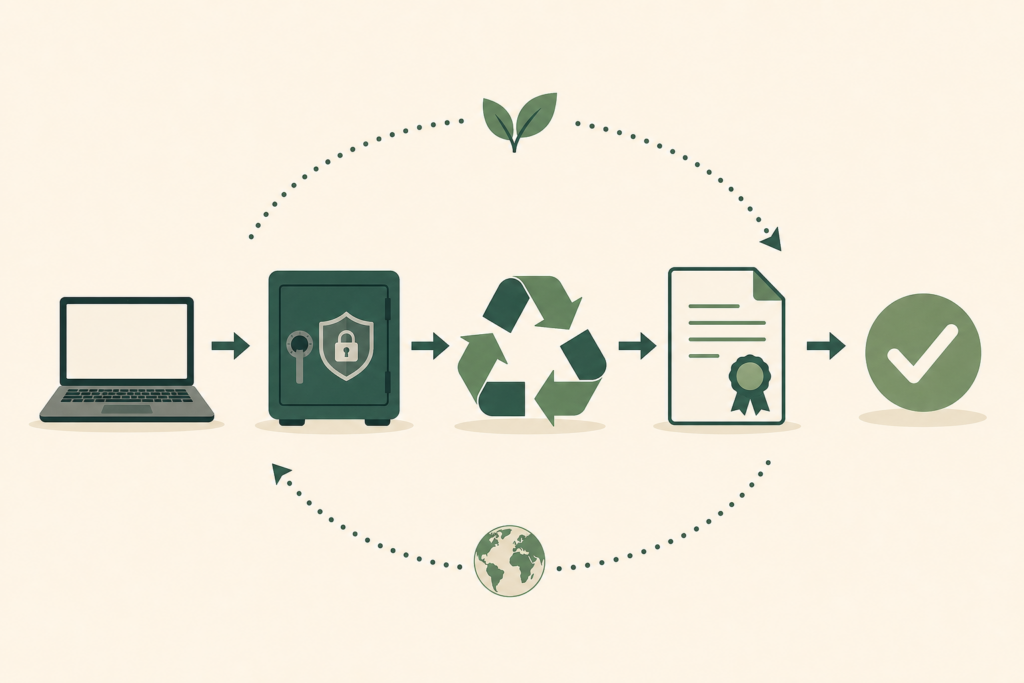
The 8-Step IT Recycling Process for UK Businesses
The following steps represent IT asset disposal best practices for UK organisations. They are sequenced to ensure compliance at every stage, from the moment you decide a device is end-of-life through to the documentation you need to retain for regulatory purposes.
Pro Tip: Start Before You Need To
The best time to plan your IT recycling process is during a new device procurement cycle, not when devices are already sitting in a storeroom. Building disposal planning into your asset lifecycle from day one prevents the rushed, non-compliant disposal decisions that create real legal exposure.
Step 1: Audit Your IT Inventory
Before any device leaves your premises, you need a complete, accurate inventory of everything scheduled for disposal. This is not optional bureaucracy — it is the foundation of your compliance audit trail. Under the Environmental Protection Act 1990's duty of care provisions, you must be able to account for every item of waste you transfer.
Your inventory should capture, for each device:
- Make, model, and serial number — Required for waste transfer notes and certificates of destruction
- Asset tag or internal reference — Links to your internal IT asset management system
- Data classification — What category of personal or sensitive business data the device held
- Last user — Important for GDPR accountability; you need to know whose data may be on the device
- Condition — Working, partially working, or non-functional (affects whether buyback value applies)
- Storage media present — HDDs, SSDs, encrypted drives, removable media bays
A properly maintained IT asset register makes this step straightforward. If your organisation does not maintain one, use this disposal process as the catalyst to start. CMDB or spreadsheet-based registers both work; the key is consistency and completeness.
Step 2: Choose a Licensed UK IT Recycler
Selecting the right recycling partner is the single most important decision in the entire process. The IT recycling market in the UK includes compliant specialists and operators who provide worthless paperwork with no genuine security or environmental value. Knowing what to look for separates the two.
For business IT asset disposal, your recycler must hold, as a minimum:
- Environment Agency Waste Carrier Licence (Upper Tier) — This is a legal requirement for anyone transporting controlled waste commercially. Verify any provider at the Environment Agency public register. Lower-tier or exemption-only carriers are not appropriate for business WEEE.
- Environment Agency T11 Exemption or Appropriate Permit — Recyclers who store and process WEEE at their facility must hold the appropriate Environment Agency authorisation. T11 exemption covers many legitimate operations; always verify the specific authorisation covers the type of equipment you are disposing of.
- ISO 27001 Certification — The international standard for information security management. An ISO 27001-certified recycler has audited processes for handling data-bearing media, controlling physical access, and managing the chain of custody for your devices. This is the most reliable indicator of genuine data security capability.
Important: Verify Credentials Independently
Always check waste carrier licence numbers directly on the GOV.UK Environment Agency register, not just via the provider's website. Credentials should be current — licences can lapse. ISO 27001 certificates should show a current third-party certification body (such as BSI, LRQA, or Bureau Veritas) and a valid expiry date.
Innovent Recycling holds ISO 27001 certification, an Environment Agency upper-tier waste carrier licence, and T11 exemption, providing full compliance for business computer recycling across the UK.
Step 3: Schedule Your Collection
Once you have selected a licensed recycler, the collection process should be straightforward. Most reputable UK IT recyclers offer free nationwide collection for business quantities, typically from 5-10 items upwards. The economics work because functional equipment has refurbishment and resale value that offsets collection costs.
When booking your collection, confirm the following in writing:
- The exact items to be collected (using your inventory from Step 1)
- That a waste transfer note will be issued on collection
- The data destruction standard to be applied (see Step 4)
- That individual certificates of destruction will be provided per device
- The expected turnaround time for documentation
- GPS-tracked vehicle confirmation (best practice for chain of custody)
For large or multi-site collections, agree a project plan in advance. Trying to coordinate the collection of hundreds of devices from multiple locations without a clear timeline creates operational risk and documentation gaps.
Step 4: Secure Data Destruction
Secure data destruction is the legal and ethical core of responsible IT recycling. Under UK GDPR Article 32, organisations must implement appropriate technical measures to ensure the security of personal data, including its secure deletion when no longer required. Article 5(1)(f) reinforces this, requiring protection against unauthorised processing throughout the data's entire lifecycle.
The ICO's data security guidance is explicit: businesses that hand devices to third parties without verifying data destruction methods are not compliant. A factory reset does not meet the standard. Even BitLocker encryption, while good practice, does not by itself satisfy the destruction requirement — the underlying data must be rendered unrecoverable.
The recognised destruction methods for business IT equipment are:
- Overwriting to NIST 800-88 Rev.1 — The US National Institute of Standards and Technology's Guidelines for Media Sanitization are the internationally recognised standard for software-based data wiping. For hard drives, this typically involves multiple overwrite passes. For SSDs and flash storage, the Secure Erase command under NIST 800-88 is the appropriate method, as overwriting is less effective on flash media.
- Physical shredding / degaussing — For the highest security requirement (government, healthcare, defence), physical destruction of the storage medium provides absolute assurance that data cannot be recovered. Shredding reduces hard drives to fragments; degaussing destroys the magnetic field on HDDs. SSDs require physical shredding as they are unaffected by degaussing.
- On-site destruction — Where chain of custody requirements are stringent, some recyclers including Innovent offer on-site data destruction using specialist equipment brought to your premises. The media is destroyed before it leaves your building, and your staff can witness the process.
Step 5: WEEE-Compliant Processing
Once data destruction is complete, the physical equipment must be processed in accordance with the Waste Electrical and Electronic Equipment (WEEE) Regulations 2013. These regulations implement the EU WEEE Directive into UK law and establish strict requirements for how electronic equipment must be collected, treated, recovered, and recycled.
As a business, your obligations under WEEE Regulations include:
- Transfer only to authorised facilities — Business WEEE must be transferred only to licensed waste carriers and processed at appropriately permitted treatment facilities. Disposing via general waste, fly-tipping, or transferring to unlicensed parties are serious offences.
- Waste transfer notes — Every transfer of business waste, including WEEE, requires a waste transfer note signed by both the transferor (your business) and the carrier or receiving facility. These must be retained for two years.
- Segregation requirements — WEEE should be kept separate from general commercial waste prior to collection. Mixing WEEE with general waste complicates compliance and may breach your duty of care obligations.
A key principle of WEEE treatment is the waste hierarchy: the recycler must first attempt to refurbish and reuse equipment before moving to materials recovery (component recycling) and, lastly, energy recovery. Disposal to landfill is prohibited for WEEE. Asking your recycler what happens to non-refurbishable devices is a reasonable due diligence question.
Step 6: Obtain Destruction Certificates and Waste Transfer Notes
Documentation is not the end of the process — it is the proof of the process. Without appropriate documentation, you cannot demonstrate compliance to the ICO, the Environment Agency, or your own auditors. This is especially critical for organisations subject to ISO 27001 Annex A.8.10 (media disposal), Cyber Essentials, or sector-specific regulations such as those applicable to healthcare, financial services, or the public sector.
The documentation package you should receive from a compliant recycler includes:
- Certificate of Data Destruction — Issued per device (or per batch with serial number appendix), confirming the method and standard used, date of destruction, and the technician or facility responsible
- Waste Transfer Note (WTN) — The legal document required under the Environmental Protection Act 1990, confirming transfer of waste from your business to the licensed carrier and/or facility
- Asset report / manifest — A reconciliation of all items collected against your original inventory, confirming every device has been processed and accounted for
- WEEE processing confirmation — Evidence that equipment has been processed at an appropriately authorised facility in compliance with the WEEE Regulations 2013
Retain all documentation for a minimum of two years (the statutory requirement for waste transfer notes). Many organisations retain data destruction certificates for longer given the potential for historical data breach investigations.
ISO 27001 Annex A.8.10 Requirement
Organisations certified to ISO 27001 must implement controls under Annex A.8.10 (media disposal) that ensure information stored on media is not accessible to unauthorised parties when disposed of or reused. The certificate of destruction from your recycler is the primary evidence for this control during an audit.
Step 7: Explore Buyback and Asset Recovery Value
IT recycling need not be a pure cost. Many end-of-life business assets retain residual value that can offset disposal costs or generate direct income. IT equipment buyback is a formal service offered by specialist recyclers where functional or refurbishable devices are appraised, and a cash or credit payment is made to your organisation.
Asset categories with the strongest buyback value include:
- Business-grade laptops under 5 years old — Particularly Lenovo ThinkPad, Dell Latitude, and HP EliteBook lines
- Enterprise servers — Dell PowerEdge, HP ProLiant, and Cisco UCS systems with RAM and storage intact
- Networking equipment — Cisco, Juniper, and HP/Aruba switches and routers in working order
- Bulk phone fleet retirement — Managed smartphone and tablet refresh programmes
The buyback valuation should be agreed in writing before collection, with clear terms on what happens to items that fail testing. Ensure the provider confirms that data destruction occurs before any refurbished device enters the secondary market — this is non-negotiable from a UK GDPR perspective regardless of whether devices are recycled or resold.
Step 8: Document for Ongoing Compliance
The final step is integrating your disposal records into your broader compliance frameworks. This is increasingly important as regulatory requirements converge on end-of-life asset management from multiple directions simultaneously.
Key compliance contexts where disposal documentation matters:
- UK GDPR Article 32 and Article 5(1)(f) — Your data destruction certificates demonstrate you have implemented appropriate technical measures for the security of personal data throughout its lifecycle, including at disposal. The ICO can request this evidence during an investigation or complaint response.
- GDPR Records of Processing Activities (RoPA) — Update your RoPA to record the disposal event, including the legal basis, data categories destroyed, and the third party responsible for processing (your recycler). This demonstrates accountability under Article 5(2).
- Scope 3 Category 12 (End-of-Life Treatment of Sold Products) — For organisations producing GHG emissions reports under UK Streamlined Energy and Carbon Reporting (SECR) or the Task Force on Climate-related Financial Disclosures (TCFD) framework, the environmental processing of your IT assets contributes to Scope 3 Category 12 reporting. Request carbon impact data from your recycler to support this.
- Cyber Essentials and Cyber Essentials Plus — The NCSC's Cyber Essentials scheme requires evidence that decommissioned devices have been securely sanitised. Certificates of destruction provide this evidence.
DEFRA Digital Waste Tracking: October 2026 Deadline
The Environment Agency's Digital Waste Tracking system becomes mandatory in October 2026. Businesses transferring waste — including WEEE — will need to log transfers digitally via the GOV.UK waste tracking service rather than paper-based waste transfer notes. Start working with recyclers now who have systems capable of generating digital waste tracking records, to avoid compliance gaps at the changeover date.
UK Compliance Framework: What the Regulations Actually Require
Understanding IT recycling best practices in the UK requires a working knowledge of the three regulatory pillars that govern business IT disposal. Many businesses are aware of GDPR but underestimate the separate obligations imposed by waste management and environmental law.
WEEE Regulations 2013
The Waste Electrical and Electronic Equipment Regulations 2013 (SI 2013/3113) place obligations on producers, distributors, and business users of electronic equipment. For businesses disposing of IT assets, the key requirements are: only transfer WEEE to authorised treatment facilities or licensed waste carriers; maintain waste transfer notes; and ensure WEEE is not mixed with general commercial waste.
The Environment Agency enforces WEEE compliance and can issue fixed penalty notices and prosecution for serious breaches. Fly-tipping electronic equipment carries unlimited fines and can result in director-level criminal liability.
UK GDPR and Data Protection Act 2018
The data security obligations relevant to IT disposal primarily derive from UK GDPR Article 32 (security of processing) and the linked requirement under Article 5(1)(f) for integrity and confidentiality throughout the data lifecycle. The ICO has published sector-specific guidance making clear that businesses must verify data destruction when transferring devices to third parties, and that standard deletion or factory reset is insufficient.
ISO 27001:2022 Annex A.8.10 — Media Disposal
For organisations certified to ISO 27001 or working towards certification, Annex A.8.10 (Media Disposal) is a specific control requiring formal procedures for the secure disposal of media containing information assets. The standard requires that procedures are documented, that appropriate destruction methods are applied according to data classification, and that evidence of destruction is retained. Using a certified recycler with documented processes is the most straightforward way to satisfy this control.
Key Takeaways
- Audit before disposal: Every device must be inventoried before leaving your premises — serial numbers, data classification, and last-user details create your compliance audit trail.
- Verify credentials independently: Check waste carrier licence numbers on the GOV.UK Environment Agency register and confirm ISO 27001 certificates show a valid third-party certification body.
- Free collection is standard: Most reputable UK IT recyclers offer free nationwide collection for business quantities of 5-10+ items — you should not typically pay for collection of working equipment.
- NIST 800-88 is the data standard: For overwriting, specify NIST 800-88 Rev.1. For SSDs and flash storage, the Secure Erase command or physical shredding is required — overwriting alone is insufficient.
- WEEE compliance is separate from GDPR: Both sets of obligations must be satisfied. Data destruction certificates satisfy UK GDPR; waste transfer notes satisfy the WEEE Regulations 2013 and Environmental Protection Act 1990.
- Keep records for at least two years: Waste transfer notes have a statutory two-year retention requirement. Data destruction certificates should be retained longer given potential ICO investigation timescales.
- Buyback can offset costs: Business-grade equipment under five years old often has significant residual value. Get a written buyback appraisal before agreeing to any disposal arrangement.
- Plan for Digital Waste Tracking: The DEFRA system becomes mandatory in October 2026. Ensure your recycler can generate digital records compatible with the GOV.UK platform.
Frequently Asked Questions
How do I recycle business IT equipment legally in the UK?
To recycle business IT equipment legally in the UK, you must transfer it to a licensed waste carrier holding an upper-tier Environment Agency waste carrier licence, and ensure it is processed at an appropriately permitted facility under the WEEE Regulations 2013. You must obtain and retain waste transfer notes for a minimum of two years. For any devices that held personal data, you must also ensure certified data destruction in accordance with UK GDPR Article 32 and receive a certificate of destruction. Using a specialist IT recycler who provides all documentation as standard is the simplest way to meet all obligations simultaneously. See our computer recycling service for compliant disposal.
Is IT recycling free for UK businesses?
Yes, free IT recycling collection is standard for UK businesses disposing of 5-10 or more items. Reputable recyclers offer free collection because functional equipment has refurbishment and resale value. For smaller quantities, collection charges may apply, or you may be able to drop equipment at a recycler's facility. Data destruction and documentation services are included by most professional IT recyclers as part of the overall service. Innovent provides free nationwide collection for qualifying business quantities.
What data destruction standard should UK businesses specify?
UK businesses should specify NIST 800-88 Rev.1 (Guidelines for Media Sanitization) as the overwriting standard for hard drives. For SSDs and flash-based storage, NIST 800-88 recommends the Secure Erase command or, for the highest assurance, physical shredding. The ICO does not mandate a specific technical standard in its guidance but expects that the method used is proportionate to the data classification and renders the data unrecoverable. Physical shredding or degaussing provides absolute assurance and is appropriate for confidential or sensitive data. Innovent's secure data destruction service covers all these methods.
What documents should I receive after IT recycling?
After compliant IT recycling, you should receive: (1) a Certificate of Data Destruction per device or per batch with serial number appendix, confirming the destruction method and date; (2) a Waste Transfer Note signed by your business and the carrier or facility, as required under the Environmental Protection Act 1990; (3) a full asset manifest reconciling all collected items against your original inventory; and (4) WEEE processing confirmation showing equipment was treated at an appropriately authorised facility. This documentation package is what you will need to demonstrate compliance to the ICO, the Environment Agency, or internal auditors. Retain everything for a minimum of two years.
How long does the IT recycling process take?
Collection can typically be arranged within 3-10 business days for standard quantities. Data destruction and processing usually takes 1-3 working days after collection. Full documentation (certificates, asset report, waste transfer notes) is typically issued within 5-10 working days of collection for straightforward disposals. Larger or more complex projects — such as multi-site collections or collections involving specialist equipment — may take longer and should be planned with lead times of 2-4 weeks. On-site data destruction services can often be arranged more quickly as there is no transport step.
What types of IT equipment can be recycled?
A specialist IT recycler can handle virtually all categories of business electronic equipment, including: desktop computers and workstations; laptops and tablets; servers and storage arrays; network switches, routers, and firewalls; monitors and display equipment; printers and multifunction devices; UPS units and power distribution equipment; mobile phones and smartphones; hard drives and SSDs as standalone items; and telecoms equipment. Equipment does not need to be working to be accepted — broken or non-functional items can still be safely processed for materials recovery. Contact Innovent to confirm acceptance of any specific equipment type.
Can I get money back for old IT equipment?
Yes, many end-of-life business IT assets retain residual value. Innovent's IT equipment buyback service pays businesses for functional or refurbishable equipment. The strongest values are typically achieved for business-grade laptops under five years old, enterprise servers with RAM and storage, and Cisco or HP networking equipment in working order. Buyback values are agreed in writing before collection. Even if devices are beyond functional use, the materials in electronic equipment have scrap value that can be credited against collection or processing costs. Ask for a written appraisal when requesting a collection quote.
What is the difference between IT recycling and WEEE disposal?
IT recycling is the broader process of responsibly retiring and processing business technology assets, encompassing data destruction, physical processing, and documentation. WEEE disposal specifically refers to compliance with the Waste Electrical and Electronic Equipment Regulations 2013, which govern how electronic equipment must be handled as a category of controlled waste. All IT recycling must comply with WEEE regulations, but IT recycling also involves data protection obligations under UK GDPR that are separate from WEEE. In practice, a specialist IT recycler handles both simultaneously, but it is important to understand that you have obligations under two distinct regulatory frameworks, not one.
Do I need to remove hard drives before IT recycling?
No. With a reputable, ISO 27001-certified IT recycler, you do not need to remove hard drives before collection. The recycler's process covers secure data destruction as part of the service. In fact, removing drives yourself before collection carries its own risk — drives sitting loose in an office environment without documented custody are themselves a data security exposure. The safest approach is to leave devices intact, document them in your inventory with drive details noted, and let the recycler's certified destruction process handle the data security element. You will then receive individual certificates of destruction per device confirming this was completed.
Found this guide helpful? Share it!
Help other UK businesses discover compliant IT recycling best practices



About Innovent Recycling
Innovent Recycling is a UK-based specialist in secure IT asset disposal and recycling. With ISO 27001 certification, Environment Agency T11 exemption, and an upper-tier waste carrier licence, we provide comprehensive, fully compliant IT recycling solutions for businesses across the United Kingdom.
Our services include:
- IT Equipment Recycling — Secure, compliant disposal of all business IT assets with full documentation
- Certified Data Destruction — NIST 800-88 overwriting and physical shredding with certificates per device
- IT Equipment Buyback — Recover value from end-of-life business assets
- Nationwide Collections — Free collection service available across the UK
Trusted by UK businesses for secure, compliant IT disposal. View our accreditations and certifications.
Ready to Recycle Your IT Equipment Compliantly?
Get a free quote for secure IT asset disposal with full WEEE compliance, certified data destruction, and waste transfer notes included.
Or call us on 0151 355 5482