
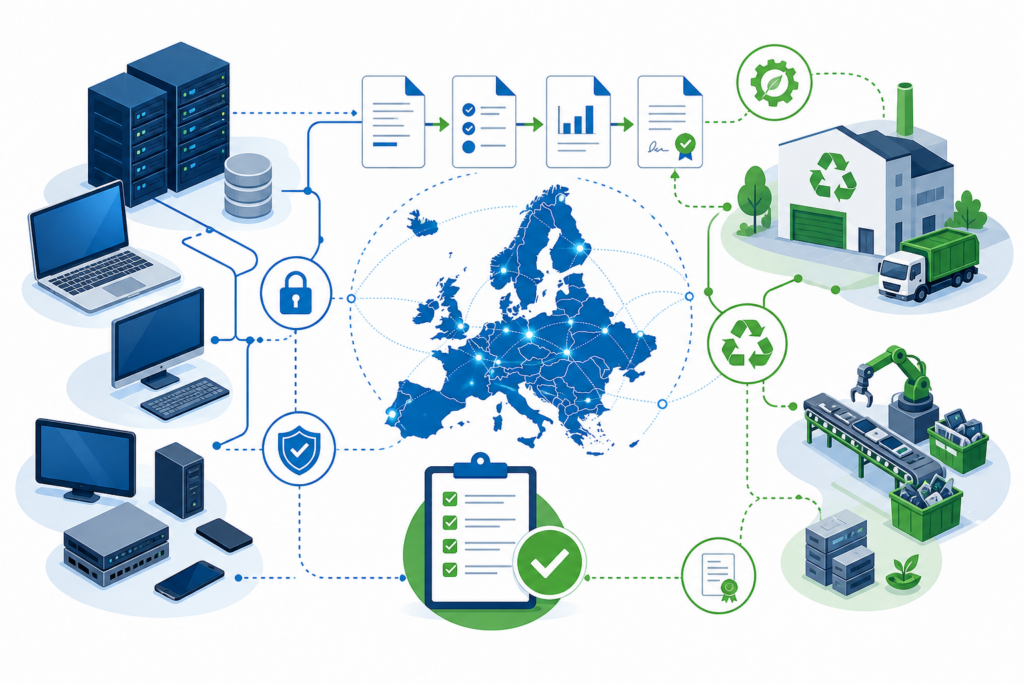
Is Your Business Ready for the EU's New Digital Waste Shipment Rules?
DIWASS (Digital Waste Shipment System) is the EU's mandatory electronic platform for managing transboundary waste shipment notifications under Regulation (EU) 2024/1157. As of 21 May 2026, prior-informed-consent (PIC) procedures for hazardous waste, waste for disposal, and certain other regulated streams must be processed through DIWASS digitally. If your business ships end-of-life IT equipment to EU-based recyclers, you need to understand how this affects your compliance obligations.
For UK businesses managing IT asset disposal, DIWASS represents a significant shift in how cross-border waste documentation works. It does not mean UK companies register with DIWASS directly, but it does mean your EU recycling partners must use it, and the documentation trail they provide you will change. Getting this wrong exposes you to compliance gaps at the border.
Important: Two Different Systems
DIWASS is the EU's digital waste shipment platform. The UK operates a separate digital tracking system under DEFRA. These are distinct regulatory regimes. For full detail on the UK system, see our guide to DEFRA's digital waste tracking for IT assets.
Published: May 2026
What is DIWASS?
DIWASS stands for Digital Waste Shipment System. It is the European Commission's centralised electronic platform for managing transboundary waste shipment notifications, consignment documents, and movement tracking across EU member states.
The legal basis is Regulation (EU) 2024/1157 on shipments of waste, with interoperability requirements set out in Commission Implementing Regulation (EU) 2025/1290. Together, these regulations replace the previous paper-heavy notification procedures with a digital-first system designed to close enforcement gaps, improve data quality, and enable real-time tracking of regulated waste flows across EU borders.
Before DIWASS, transboundary waste shipments required physical notification documents, wet signatures from multiple competent authorities, and paper consignment notes accompanying each load. The process was slow, difficult to audit in real time, and prone to transcription errors that created compliance exposure for everyone in the chain.
DIWASS replaces much of this with digital notifications, electronic signatures, real-time status tracking, and structured data exchanges between national competent authorities. The platform operates at EU level, with EU-established operators, including notifiers, consignees, treatment facilities, and carriers, registering directly.
You can find the Commission's implementation guidance and the Green Forum's dedicated DIWASS resources on the EU environment portal and the DIWASS Green Forum page.
What Actually Went Digital on 21 May 2026?
The 21 May 2026 date is real and significant, but it applies to specific waste streams, not all shipments equally. This distinction matters for IT asset disposal planning.
Digital-Only from 21 May 2026: PIC and Notification Procedures
The prior-informed-consent (PIC) and notification procedures are now fully digital via DIWASS. These cover:
- Hazardous waste shipments requiring notification
- Mixed municipal waste exports
- Waste destined for disposal (rather than recovery)
- Contaminated waste subject to notification requirements
- Certain plastic waste exports to non-OECD countries (with an additional ban on plastic waste exports to non-OECD countries taking effect from 21 November 2026)
For these streams, EU-established operators are no longer able to use paper notification documents. Everything goes through DIWASS.
Green-List Waste (Annex VII): Transition Period Until 31 December 2026
This is the nuance the brief got wrong, and it is critical for IT asset disposal planning. Green-listed non-hazardous waste destined for recovery (covered by Annex VII of the regulation) has a transition period until 31 December 2026. Operators may still use paper Annex VII documentation for these shipments until that date.
Why does this matter for IT equipment? A significant proportion of end-of-life IT hardware destined for recovery, rather than disposal, can qualify for the green list. The classification depends on the hazardous content of the specific equipment. Standard laptops and desktop computers with no battery issues and no CRT screens can often be green-listed for recovery. However:
- Lithium-ion batteries can push shipments into the notification/PIC stream
- CRT monitors (now rare, but still encountered in legacy IT refreshes) contain lead and require notification procedures
- Mixed loads containing both green-list and non-green-list items fall under the stricter classification
- Equipment destined for disposal rather than recovery is not green-listed regardless of hazardous content
Pro Tip: Ask Your Recycler to Classify Your Equipment
Before any cross-border EU shipment of IT assets, ask your recycler to confirm the classification. Green-list for recovery, or PIC/notification required? The answer determines whether DIWASS digital procedures are mandatory now or whether Annex VII paper documentation remains valid until 31 December 2026. A competent recycler should be able to confirm this based on the equipment type and intended processing route.
The Reuse Exception: When IT Equipment is Not "Waste" at All
One further point worth noting: functioning IT equipment shipped across EU borders for genuine reuse may not be classified as waste at all under the Waste Shipment Regulation. If equipment is operational, tested, and being transferred for continued use rather than recycling or disposal, it may fall outside DIWASS scope entirely. The key test is whether the transfer constitutes a shipment of waste or a movement of a product. This distinction matters for organisations running cross-border IT refresh programmes where older but working equipment moves to secondary markets or overseas offices.
How DIWASS Affects UK Businesses Shipping IT Waste to the EU
UK businesses do not register with DIWASS. The system is for EU-established operators, and the UK is a third country following Brexit. However, DIWASS directly affects UK organisations in several practical ways.
Your EU Recycling Partner Must Be DIWASS-Ready
If you send end-of-life IT equipment to an EU-based treatment facility, that facility (as the consignee or notifier under the notification procedure) is responsible for using DIWASS for any procedures now covered by the digital mandate. If they cannot demonstrate DIWASS compliance, they may not lawfully process your PIC-regulated shipments from 21 May 2026 onwards.
This creates a straightforward due-diligence question to add to your supplier assessments: has your EU recycling partner registered with DIWASS and completed any required staff training on the platform? If the answer is unclear, that is a gap in your compliance chain.
UK Subsidiaries and EU Operations
If your organisation has EU-based subsidiaries, operations, or regional offices that handle IT equipment disposal independently, those entities are subject to EU waste shipment law directly. They are EU-established operators and may need to register with DIWASS if they are involved in cross-border waste shipments within the EU or importing waste from outside it. This is particularly relevant for multinational businesses with mixed UK and EU operations running shared IT refresh cycles.
UK vs EU: Two Separate Compliance Regimes
It is important not to conflate DIWASS with UK domestic waste tracking. The UK has its own digital waste tracking requirements under DEFRA, which apply to domestic waste movements within England. These are separate from EU requirements under Regulation (EU) 2024/1157. For UK businesses with EU-bound shipments, both regimes may be relevant at different points in the chain. Our separate guide on DEFRA's digital waste tracking for IT assets covers the UK domestic side. For the cross-border dimension, this guide focuses on DIWASS.
For the UK government's current guidance on importing and exporting waste internationally, see the GOV.UK waste import and export guidance.
DIWASS Requirements and the Practical Process
Understanding the DIWASS process helps you ask the right questions of your recycling partners and build appropriate audit trails on your side.
For PIC/Notification-Covered Waste (Digital-Only Now)
Where DIWASS applies, the process broadly works as follows:
- Registration: EU-established operators (notifier, consignee, treatment facility, carriers) register on the DIWASS platform.
- Electronic notification: The notifier submits the waste shipment notification electronically through DIWASS, replacing the previous paper forms.
- Competent authority review: The competent authorities in both the country of dispatch and the country of destination review and approve (or object to) the notification via the platform. Tacit consent rules still apply where relevant.
- Movement tracking: When the shipment moves, an electronic movement document replaces the paper consignment note. Carriers update the system at collection and delivery.
- Completion certificate: The treatment facility confirms completion through DIWASS, generating an electronic certificate of recovery or disposal.
For UK businesses, the practical implication is that the paper certificates you may have received from EU recyclers in the past will, for PIC-covered shipments, be replaced by digital documentation from DIWASS. You should be asking your EU partners what format their completion certificates now take and ensuring your compliance records reflect this change.
For Green-List/Annex VII Waste (Paper Still Valid Until 31 December 2026)
Where shipments qualify as green-list (non-hazardous waste for recovery, Annex VII), operators may continue using paper Annex VII consignment documents until the end of 2026. If your IT equipment is correctly classified as green-list for recovery, your EU recycler does not yet need to use DIWASS for that movement, and paper documentation remains valid. From 1 January 2027, the expectation is that these shipments will also move to DIWASS, though you should monitor the Commission's implementation guidance as that date approaches.
The prudent approach is to start using DIWASS-compliant partners now even for green-list shipments, so the transition at end-2026 is not a sudden operational disruption.
Compliance Risks and Enforcement
Non-compliance with EU waste shipment requirements has always carried enforcement risk. DIWASS increases enforcement capability by giving competent authorities real-time visibility of shipment status, reducing the ability to use incomplete or fraudulent paper documentation.
For UK exporters, the relevant enforcement bodies are:
- The Environment Agency (EA) in England, which regulates waste exports under UK post-Brexit waste shipment controls. The EA can refuse export consent, issue enforcement notices, and pursue criminal prosecution for illegal waste exports.
- EU competent authorities in the countries of transit and destination, which retain the right to refuse, return, or seize non-compliant shipments.
- Border Force and port authorities, which conduct physical checks on waste shipments at UK ports.
The consequences of non-compliance can include shipments being refused at EU borders, costs of return shipment falling back on the UK exporter, criminal prosecution under the Transfrontier Shipment of Waste Regulations, and reputational damage. For businesses whose ESG credentials are under scrutiny from investors or procurement teams, an enforcement action in this area carries disproportionate reputational cost.
The practical message: if you have EU-bound IT waste shipments in your asset disposal programme, verifying your partner's DIWASS readiness is not optional due diligence. It is a baseline requirement.
What UK Businesses Should Do Now
The transition to DIWASS is not something UK businesses need to manage directly on the platform, but it does require active steps to verify your supply chain and update your compliance documentation processes.
1. Map Your EU-Bound IT Disposal Routes
Start by identifying whether any of your IT disposal routes involve equipment moving to EU-based treatment facilities. For many UK businesses with domestic IT asset disposal, this may not apply at all. For organisations with pan-European operations or specialist equipment types that route through EU recyclers, it is essential to have clarity on this.
2. Audit Your Recycling Partners' EU Shipment Capability
For any EU-bound shipments, verify that your recycling partner:
- Is registered with the relevant EU competent authorities for cross-border waste shipments
- Has confirmed DIWASS registration and capability for PIC-covered shipments
- Can provide digital completion certificates issued through DIWASS for notification-covered waste
- Has correctly classified your equipment (green-list for recovery vs PIC/notification required)
For secure IT equipment recycling with a fully documented chain of custody, choosing a partner with the right accreditations and verified EU compliance capability is non-negotiable. Our accreditations page sets out Innovent's own certifications, including ISO 27001 and our Environment Agency T11 exemption.
3. Update Your Internal Compliance Records
Your compliance records for EU-bound IT waste shipments will need to reflect that digital documentation from DIWASS replaces paper notification documents for PIC-covered waste. Update your supplier audit templates, waste transfer documentation checklist, and data destruction certificate request process accordingly. For certified data destruction in particular, ensure your certificate of destruction is issued separately from and in addition to DIWASS shipment documentation, as these serve different compliance purposes.
4. Plan Ahead for the Green-List Transition (End of 2026)
Even where your shipments currently qualify for the green-list paper transition, the expectation is full digital processing through DIWASS from January 2027. Do not wait until December 2026 to check whether your EU partners are ready for this. Start the conversation now, ensure they have a clear transition plan, and build the documentation change into your IT asset disposal processes ahead of time.
5. Consider Whether Equipment Should Move as Product, Not Waste
For IT equipment with residual value that is still operational, explore whether transfer for reuse qualifies as a product movement rather than a waste shipment. A specialist with IT equipment buyback capability can assess equipment, provide valuations, and determine the appropriate classification, potentially taking certain cross-border movements outside DIWASS scope entirely.
How Innovent Recycling Can Help
Innovent Recycling is a UK-based ITAD specialist with ISO 27001 certification, an Environment Agency T11 exemption, and upper-tier Waste Carrier Licence. We handle IT equipment recycling and certified data destruction for businesses across the UK.
To be explicit on the DIWASS question: Innovent is not DIWASS-registered and does not process DIWASS notifications directly. DIWASS is the EU's system for EU-established operators, and Innovent operates under UK regulatory frameworks. Where client requirements involve EU-bound shipments, we work with a network of EU-registered recycling partners who have the appropriate EU competent authority approvals and DIWASS capability.
What we do provide is:
- Equipment classification: Assessing whether your IT assets fall under PIC/notification procedures or green-list for recovery, so you understand the regulatory requirements before collection
- Partner coordination: Liaising with EU-registered recyclers and ensuring DIWASS-compliant documentation is in place where required
- UK-side documentation: Full waste transfer documentation, data destruction certificates, and chain-of-custody records for your compliance files under UK law
- Data destruction before shipment: ISO 27001-backed secure data wiping to HMG Infosec Standard 5, so data security is handled before equipment leaves your site, regardless of where it is ultimately processed
- Buyback assessment: Identifying whether equipment qualifies for IT asset buyback and reuse classification, potentially taking movements outside waste shipment regulation scope
If you have an IT asset disposal programme that includes cross-border shipments, or if you are simply unsure how DIWASS affects your current recycler's documentation, get in touch to discuss your requirements.
Key Takeaways
- DIWASS is live from 21 May 2026 for PIC/notification-covered waste, including hazardous IT waste streams. Paper is no longer accepted for these procedures by EU-established operators.
- Green-list waste (Annex VII) has until 31 December 2026 to transition. Non-hazardous IT equipment destined for recovery may still use paper documentation until then, but classification matters.
- UK businesses do not register with DIWASS directly. Your EU recycling partners must be registered. Your due diligence task is verifying they are.
- EU subsidiaries are in scope. If your organisation has EU-based operations handling cross-border waste shipments, those entities face direct DIWASS obligations.
- Functioning equipment for reuse may not be waste. Cross-border transfers of operational IT equipment for genuine reuse may fall outside WSR/DIWASS scope entirely.
- DIWASS and DEFRA tracking are separate systems. UK domestic digital waste tracking under DEFRA is a different regime. Both may be relevant at different points in your disposal chain.
- Data destruction should be completed before shipment regardless of waste classification, ensuring data security is not dependent on the downstream processing route.
Frequently Asked Questions
What is DIWASS and when did it come into force?
DIWASS (Digital Waste Shipment System) is the European Commission's centralised platform for processing transboundary waste shipment notifications electronically. It is established under Regulation (EU) 2024/1157. From 21 May 2026, prior-informed-consent (PIC) and notification procedures for hazardous waste, waste for disposal, and certain other regulated streams became mandatory through DIWASS. Green-list (Annex VII) waste destined for recovery has a transition period, with paper documentation remaining valid until 31 December 2026.
Can I still use paper documentation for EU waste shipments?
It depends on the waste type. For PIC/notification-covered shipments (hazardous waste, waste for disposal, mixed municipal waste, contaminated waste), paper documentation is no longer accepted by EU-established operators from 21 May 2026. However, for green-listed non-hazardous waste destined for recovery (Annex VII), operators may continue using paper documentation until 31 December 2026. Much end-of-life IT equipment destined for recovery can qualify as green-list, though the specific classification depends on equipment content (batteries, CRTs, mixed loads). Always confirm classification with your recycler before assuming paper is acceptable.
Does a UK business need to register with DIWASS?
No. DIWASS registration is for EU-established operators: notifiers, consignees, treatment facilities, and carriers operating within the EU. As a UK business (a third country since Brexit), you do not register with DIWASS directly. The obligation falls on your EU-based recycling partner, who must be DIWASS-registered for any PIC-covered shipments they process. Your role is to verify that your EU partners have this capability and to ensure your compliance documentation reflects the change from paper to digital.
How do I know if my IT equipment is classified as hazardous waste for EU shipment purposes?
Classification depends on the composition and intended processing route of the equipment. Standard laptops and desktops destined for recovery can often qualify as green-list (non-hazardous for recovery), but equipment containing lithium-ion batteries, CRT screens, or certain components may fall into notification/PIC procedures. Mixed loads containing both green-list and non-green-list items are classified under the stricter category. Equipment destined for disposal (rather than recovery) is not green-listed regardless of hazardous content. A qualified ITAD specialist can advise on classification before any shipment, and your EU recycler must confirm the correct treatment under DIWASS.
What is the difference between DIWASS and the UK's DEFRA digital waste tracking system?
These are completely separate systems with separate legal bases. DIWASS is the EU's platform for cross-border (transboundary) waste shipments between EU member states and with third countries, established under Regulation (EU) 2024/1157. The UK's digital waste tracking system, developed by DEFRA and the Environment Agency, applies to domestic waste movements within England. If your IT disposal involves equipment moving within the UK and also equipment moving to EU-based recyclers, both systems may be relevant at different points in your chain. See our dedicated guide on DEFRA digital waste tracking for IT assets for the UK side.
What happens if my EU recycling partner is not DIWASS-compliant?
If your EU recycling partner cannot process PIC/notification-covered shipments through DIWASS, those shipments may be refused at EU borders or rejected by the relevant competent authorities. The consequences can include the shipment being returned at your cost, enforcement action under EU waste shipment regulations, and potential liability under UK Transfrontier Shipment of Waste Regulations. It is your responsibility as the exporter to ensure the downstream processing chain is compliant. If you cannot verify your EU partner's DIWASS status, that is a gap in your due diligence that needs addressing before the next shipment.
Does DIWASS apply to functioning IT equipment being sent abroad for reuse?
Functioning IT equipment transferred for genuine reuse may not be classified as waste at all under the Waste Shipment Regulation, in which case DIWASS requirements would not apply. The key question is whether the transfer constitutes a shipment of waste or a movement of a product. If equipment is operational, tested, and being transferred for continued use rather than recycling or disposal, it may fall outside DIWASS scope. However, this classification needs to be properly established before shipment. Equipment that is non-functional or destined for recovery/disposal is waste and subject to the applicable DIWASS requirements.
Found this guide helpful? Share it!
Help other IT and compliance teams understand DIWASS



About Innovent Recycling
Innovent Recycling is a UK-based specialist in secure IT asset disposal and recycling. With ISO 27001 certification and Environment Agency T11 exemption, we provide comprehensive, compliant recycling solutions for businesses across the United Kingdom.
Our services include:
- IT Equipment Recycling - Secure, compliant disposal of all business IT assets
- Certified Data Destruction - HMG Infosec Standard 5 compliant wiping and shredding
- WEEE Compliance Management - Full regulatory compliance and documentation
- Nationwide Collections - Free collection service available UK-wide
Trusted by businesses across the UK for secure, compliant IT disposal. View our accreditations and certifications.
Need Help with EU Waste Shipment Compliance?
Talk to Innovent about your IT asset disposal requirements. We will advise on equipment classification, DIWASS implications for your recycling chain, and handle UK-side documentation for compliant disposal.
Or call us on 0151 355 5482