
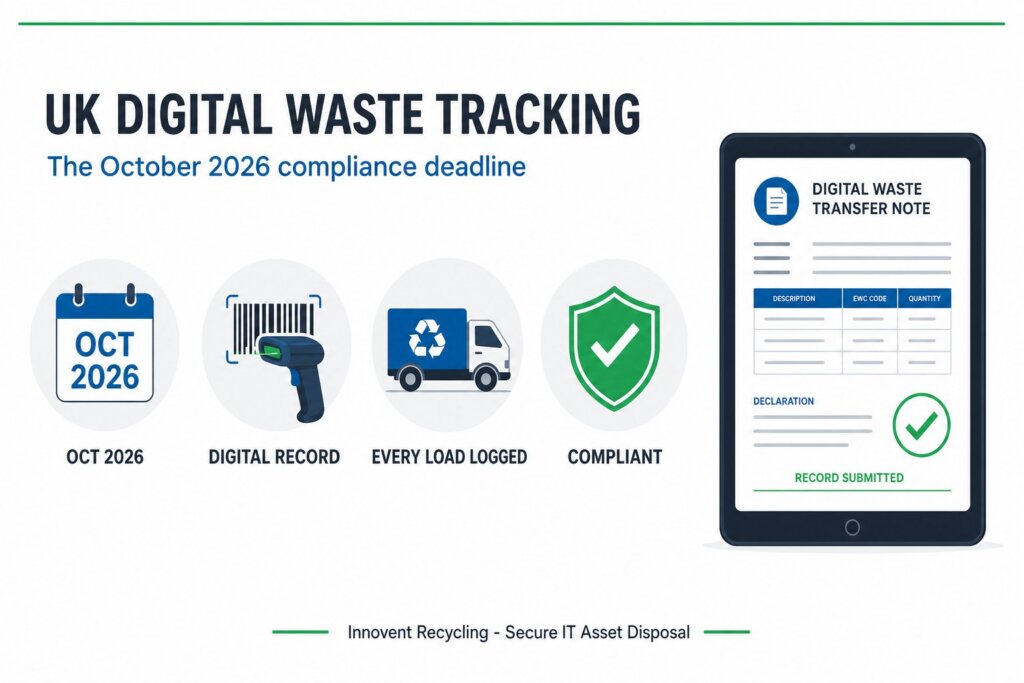
Digital waste tracking becomes mandatory in the UK from October 2026, replacing paper waste transfer notes with a single government-run digital record for every waste movement. Permitted receiving sites must comply first, followed by carriers, brokers and dealers in October 2027. This guide explains the deadlines, who must act, and what to ask your waste carrier now.
Key facts at a glance
- Digital waste tracking is mandatory for permitted waste receiving sites in England, Wales and Northern Ireland from October 2026
- Scotland follows in January 2027; waste carriers, brokers and dealers from October 2027
- The service replaces the information held on paper waste transfer notes and hazardous waste consignment notes
- Legal basis: Section 58 of the Environment Act 2021; the public beta went live on 28 April 2026
- Organisations that create or edit records pay an annual £26 charge
- Waste producers keep full duty of care responsibility — check your carrier and destination sites now
What Is Digital Waste Tracking?
Digital waste tracking is a UK government service that records every controlled waste movement in one central digital system. It was created under Section 58 of the Environment Act 2021. DEFRA delivers it with the Environment Agency and the devolved regulators. The service captures the information now spread across paper waste transfer notes and hazardous waste consignment notes. It holds this in near real-time records that regulators can query directly.
The driver is waste crime. The Environment Agency estimates that waste crime costs the UK economy around £1 billion each year. Much of it hides behind missing or false paperwork. A central digital record makes it far harder for waste to disappear between a producer and its final destination. The public beta opened on 28 April 2026, and permitted receiving sites have been recording waste voluntarily since then. From October 2026, that recording stops being optional.
When Does Digital Waste Tracking Become Mandatory?
Digital waste tracking becomes mandatory in phases, starting with permitted waste receiving sites in October 2026. The rollout then extends across the rest of the waste chain over the following year. The confirmed timeline is:
| Date | What happens | Who is affected |
|---|---|---|
| 28 April 2026 | Public beta opens (voluntary use) | Permitted waste receiving sites |
| October 2026 | Recording becomes mandatory | Permitted receiving sites in England, Wales and Northern Ireland |
| January 2027 | Recording becomes mandatory | Permitted receiving sites in Scotland |
| Spring 2027 | Public beta opens for the transport leg | Waste carriers, brokers and dealers |
| October 2027 | Phase 2 becomes mandatory | Carriers, brokers, dealers and waste exemption holders |
Phase 1 obligations sit with the sites that receive waste, not with the businesses that produce it. Our DEFRA digital waste tracking 2026 guide covers the phase 1 mechanics, penalties and preparation steps in detail.
Who Must Comply With Digital Waste Tracking?
Every organisation that produces, carries or receives business waste is affected by digital waste tracking, but the legal obligations arrive at different times. Sites that hold a permit or licence to receive waste must register and record every load from October 2026. That includes transfer stations, recycling plants, materials recovery facilities and IT processing sites. Waste carriers, brokers and dealers follow in October 2027, when the transport leg of each movement goes digital. Sites operating under waste exemptions are also brought in at phase 2.
Waste producers — the offices, schools and factories whose waste is collected — do not enter records themselves in the first phases. Their exposure is indirect but real: duty of care law makes them responsible for choosing compliant partners. Organisations that create or edit records pay an upfront annual charge of £26. This grants twelve months of rolling access to the service.
What Information Must Be Recorded?
Digital waste tracking records capture the same core information as a waste transfer note, held centrally rather than on paper. That includes a description of the waste, its classification code, the quantity, where it came from, and who handled it. Hazardous waste consignment details are added where they apply. Receiving sites must enter each load shortly after it arrives, so the record trails the physical movement by days rather than months.
Records can be submitted two ways. Larger operators connect their existing waste management software to the service through an API, so records flow automatically. Smaller operators can upload spreadsheets instead. DEFRA expects to keep that option until at least October 2027. Either way, the result is the same: a central, regulator-visible record of what moved, when, and who was responsible for it at each stage.
What Changes When Your Business Disposes of IT Equipment?
For businesses disposing of IT equipment, the biggest change is that paper waste transfer notes give way to central digital records. Today, you sign a transfer note when old laptops, servers or monitors are collected. You file your copy for two years and hope the paperwork downstream is honest. Under digital waste tracking, the facility receiving your equipment records the load in a system regulators can inspect at any time. Gaps and mismatches that paper concealed become visible.
This raises the stakes for choosing an IT asset disposal partner. If your equipment reaches an unregistered site, or collected quantities never appear at a destination, the digital trail exposes it. Duty of care liability then points back to you as the producer. The businesses that benefit are those already working with disposal partners who document every collection properly.
How Does Digital Waste Tracking Affect WEEE Compliance?
Digital waste tracking does not replace the WEEE regulations — the two regimes run in parallel. The WEEE Regulations 2013 still govern how electrical equipment must be collected, treated and evidenced. Producer responsibility obligations also stay in place. Digital waste tracking governs something different: the record of each waste movement itself. When redundant IT equipment leaves your building, WEEE rules decide where it can legally go. Digital waste tracking records that the movement happened.
There is one more layer IT disposers should keep in mind. Digital waste tracking records loads, not individual devices. A record showing that a tonne of WEEE reached a facility says nothing about which laptops were in it or what happened to their hard drives. Serial-matched asset reports remain the only audit trail that satisfies data protection scrutiny, so keep demanding them alongside waste records.
How Does Digital Waste Tracking Strengthen Your Duty of Care?
Your duty of care under section 34 of the Environmental Protection Act 1990 does not change — digital waste tracking simply makes failures easier to spot. You remain legally responsible for your business waste from the moment it is produced until it reaches final recovery or disposal. What changes is visibility. Regulators no longer need to piece together a waste trail from filing cabinets across three firms. They can query the central record and see where a movement stops making sense.
For data-bearing IT equipment, the sensible response is to pair the new movement records with destruction evidence. A digital waste record proves your servers reached a legitimate facility. Certificates of destruction prove what happened to the data on them. Together they close both compliance loops: environmental duty of care and UK GDPR accountability. One without the other leaves a gap an auditor will find.
Does Digital Waste Tracking Cover Waste Sent Abroad?
Digital waste tracking is a domestic system — waste exported from the UK falls under separate shipment rules, and those went digital too. Since 21 May 2026, the EU's DIWASS platform has handled notified waste shipments digitally under Regulation (EU) 2024/1157. Green-list Annex VII shipments move off paper by the end of 2026. UK businesses do not register with DIWASS directly, but any disposal route that ends at an EU recycler now depends on digitally compliant partners at both ends. Our DIWASS guide for UK businesses explains what to check before equipment crosses a border.
What Should You Ask Your Waste Carrier Before October 2026?
Five questions will tell you whether your waste carrier is ready for digital waste tracking. Put them in writing and keep the answers with your compliance records:
- Are you a registered waste carrier? Ask for the registration number and verify it on the public register.
- Which sites receive my waste? Permitted sites must be recording digitally from October 2026 — ask how those sites are preparing.
- How will you record my movements from October 2027? Carriers with no phase 2 plan are a risk to your duty of care.
- What documentation will I receive? You should still get your own copy of every record, in a format you can store and audit.
- For IT equipment, what happens to the data? Waste records do not evidence data destruction — ask what device-level reporting is provided.
Vague answers are the warning sign. If a carrier cannot explain its digital waste tracking plan a year out, change carriers before the deadline, not after an audit.
How Does Innovent Recycling Handle Digital Waste Tracking?
Innovent Recycling already runs a digital audit trail for every collection, so digital waste tracking is an extension of how we work rather than a scramble to comply. We are a registered Waste Carrier operating under a T11 exemption. That places our mandatory onboarding in phase 2 — October 2027 — and we are preparing well ahead of that date. Every asset we collect is serial-matched, and every customer receives asset reports and destruction certificates they can file against the new movement records.
The data side is covered to the same standard. Our ISO 27001-certified process delivers secure data destruction using NIST 800-88-compliant wiping, with HMG IS5 (Enhanced) physical destruction where required. Collection is free nationwide, from computer recycling in Manchester to sites anywhere in the UK. Everything is processed at our solar-powered Ellesmere Port facility with zero landfill, and buyback rebates apply to resalable equipment.
Frequently Asked Questions About Digital Waste Tracking
Do waste producers have to register for digital waste tracking in 2026?
No. Phase 1, from October 2026, applies to permitted waste receiving sites. Producers do not enter records in the first phases and pay no charge. Your duty of care still applies in full, so you must check that your carrier and its destination sites are compliant.
Will paper waste transfer notes still be valid after October 2026?
Receiving sites in England, Wales and Northern Ireland must record digitally from October 2026, and digital records replace the information transfer notes carried. Keep existing paper notes for the current retention period — two years, or three for hazardous consignment notes — as they remain evidence for past movements.
How much does digital waste tracking cost?
Organisations that create or edit records pay an upfront annual charge of £26, giving twelve months of rolling access. The charge applies from the mandatory phase. Waste producers who never enter records pay nothing directly, though carriers may reflect their own compliance costs in collection pricing.
Does digital waste tracking replace WEEE documentation?
No. The WEEE Regulations 2013 continue to govern how electrical equipment is collected, treated and evidenced. Digital waste tracking records the movement of waste; it does not track individual devices. For IT equipment, you still need serial-matched asset reports and destruction certificates to evidence data compliance.
What happens if a waste site ignores the October 2026 deadline?
Failing to record waste digitally will be a breach of waste regulations. Regulators can respond with formal warnings, statutory notices, civil penalties, permit suspension or revocation, and prosecution in serious cases. For producers, the practical risk is duty of care exposure from continuing to use a non-compliant site.
Ready to Get Compliant Before October 2026?
The businesses that will pass their first digital waste tracking audit are the ones whose disposal records are already clean. If your IT disposal paperwork would not survive that scrutiny today, fix it before the deadline makes it visible. Book a collection online or call us on 0151 355 5482. We collect free of charge anywhere in the UK and hand you an audit trail that is ready for the digital era.