
For a full checklist, see our main guide to what a certificate of destruction should include.
Key facts at a glance
- A data destruction certificate is your evidence that data on disposed IT equipment was erased or destroyed; UK GDPR Article 32 requires appropriate security until it is.
- It should list each item's serial number or asset tag, the method and the date.
- Check it against what you sent, as the ICO advises.
- Keep the waste transfer note too: at least 2 years (duty of care code of practice).
- Innovent issues a certificate of destruction and an asset report with each collection; collection is free for 10 or more laptops, PCs or servers.
Does Your Business Have Proof of Its Data Destruction?
When your business disposes of old IT equipment, deleting files or formatting drives does not remove the data. If the equipment held personal data, you need to be able to show what happened to it. A data destruction certificate is how you do that.
Related Reading
- Hard Drive Shredding vs Wiping: Which Is Right for Your Business? - Compare destruction methods
- IT Equipment Disposal: Complete Checklist for UK Businesses - The complete IT disposal process
What a Data Destruction Certificate Is For
A certificate of data destruction is a record from your disposal provider that the data on specific items was erased or the storage physically destroyed. UK GDPR does not name certificates, but Article 32 requires appropriate technical and organisational measures to keep personal data secure, and you remain responsible for that data until it is destroyed. If you are asked what happened to a retired laptop or server, the certificate is your answer.
The ICO's guidance on disposal and deletion tells organisations to use and document secure disposal methods, and to check that destruction certificates match what was sent for destruction.
£17.5M
Maximum UK GDPR fine, or 4% of global annual turnover if higher (Data Protection Act 2018, s157)
What a Certificate Should List
- Each item: serial number or asset tag for every data-bearing device or drive, so you can match it to your asset register
- The method: erasure to NIST SP 800-88 Rev 2 (for example a single verified overwrite pass for hard drives, or the drive's own sanitise command for SSDs), or physical destruction
- The date the data was erased or the storage destroyed
- The provider and a certificate reference you can match to the asset report
A certificate that says only "assorted equipment destroyed" cannot be matched to anything. Ask for item-level detail.
Watch for wording that does not mean what it says. NIST does not certify anyone, so "NIST certified" is not a real credential; NIST SP 800-88 Rev 2 is a set of guidelines. Multi-pass overwriting is not a mark of quality either: NIST's FAQ says it is unnecessary.
How to Check a Certificate
The ICO advises checking that destruction certificates match what you sent. In practice:
- Keep your own list of serial numbers or asset tags before collection.
- Compare it with the certificate and asset report when they arrive: every item should appear, with a method and a date.
- Query gaps — missing serials, items with no method, or a count that does not match — before you file the certificate.
- Check the method is the one you agreed for each type of device.
Your Other Records
The certificate covers the data. The waste itself needs its own paperwork: under the waste duty of care code of practice, keep the waste transfer note (the waste description) for at least 2 years for non-hazardous waste, and check that the carrier is registered.
Schools and colleges have a specific expectation: the DfE digital and technology standards say IT support should make sure they have certificates for WEEE, disposal and destruction of data when devices are disposed of, and that the IT asset register is updated.
Sample Report and Template
See what item-level reporting looks like in our sample asset report, a real report layout with no client details. If you need your own form, our certificate of data destruction template lists the fields above.
What to Ask Your Provider
- Waste carrier registration: check it on the public register. Innovent is an upper-tier registered waste carrier, broker and dealer (CBDU176790).
- ICO registration: Innovent is registered with the ICO (ZA277024, until 6 September 2027).
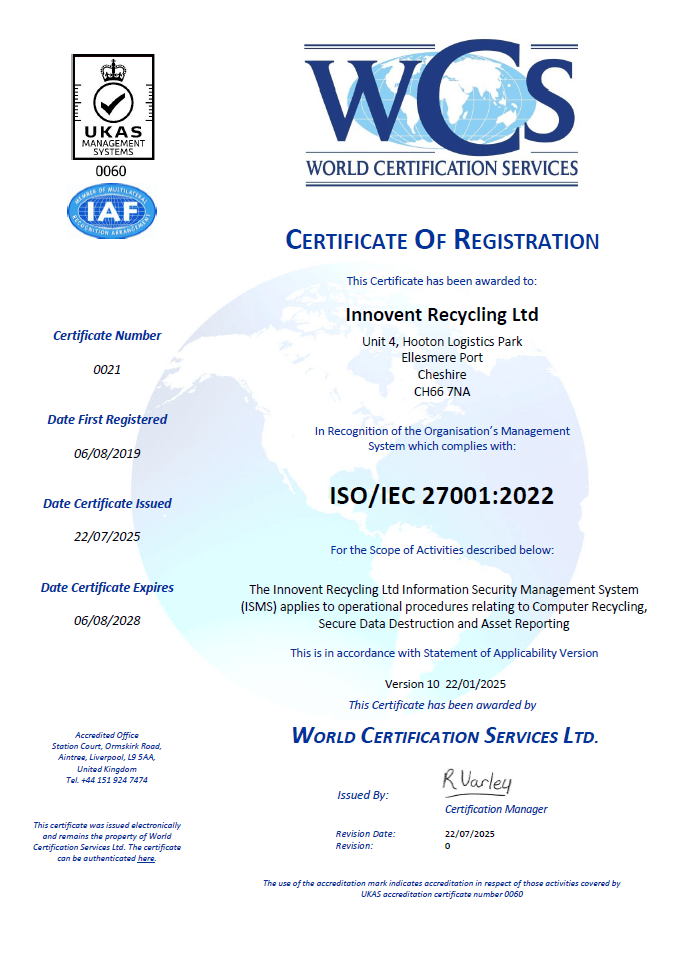
- ISO 27001: ask for the certificate and its scope. Innovent is ISO 27001:2022 certified (computer recycling, secure data destruction and asset reporting).
- A written contract: the ICO says that whenever a controller uses a processor there must be a written contract.
- The method, in writing: which standard is used for each type of device, and what happens to drives that fail verification.
How Innovent Handles Certificates
Drives are erased to NIST SP 800-88 Rev 2: a single verified overwrite pass for hard drives, the drive's sanitise command for SSDs. Drives that fail verification are physically destroyed by shredding at our facility. Each collection comes with a certificate of destruction and an asset report. See our secure data destruction service for details. Collection is free for 10 or more laptops, PCs or servers, and we offer a send-in service for smaller quantities.
Key Takeaways
- The certificate is your evidence: UK GDPR Article 32 requires appropriate security, and you are responsible until the data is destroyed.
- Item-level detail: serial or asset tag, method and date for every item.
- Check it: match it to what you sent, as the ICO advises.
- Keep the waste transfer note: at least 2 years (code of practice).
- Ignore empty labels: "NIST certified" and multi-pass claims are not quality marks.
Frequently Asked Questions
Is a data destruction certificate a legal requirement?
UK GDPR does not name certificates. Article 32 requires appropriate security for personal data, and you remain responsible for that data until it is destroyed, so you need evidence of what happened to it. The ICO tells organisations to use and document secure disposal methods and to check destruction certificates match what was sent. A certificate is the usual way to show this.
What should a data destruction certificate list?
Each data-bearing item by serial number or asset tag, the method used (erasure to NIST SP 800-88 Rev 2 or physical destruction), and the date. It should also name the provider and carry a reference you can match to the asset report.
How do I check a certificate is right?
Match it against what you sent, as the ICO advises: every serial number on your collection list should appear on the certificate with a method and a date. Query anything missing or unexplained before you file it.
How long should we keep the certificate and waste transfer note?
The waste duty of care code of practice says to keep the waste transfer note (the waste description) for at least 2 years for non-hazardous waste. UK GDPR sets no fixed period for certificates; keep them in line with your own records policy, for as long as you may need to show what happened to the data.
Do schools need data destruction certificates?
The DfE digital and technology standards for schools and colleges say IT support should make sure they have certificates for WEEE, disposal and destruction of data when devices are disposed of, and that the IT asset register is updated.
Does "NIST certified" on a certificate mean anything?
No. NIST does not certify providers or methods; NIST SP 800-88 Rev 2 is a set of guidelines. Look for the method named (for example a single verified overwrite pass or the drive's sanitise command) rather than a certification claim. NIST's FAQ says multi-pass overwriting is unnecessary.
Does Innovent provide certificates?
Yes. Each collection comes with a certificate of destruction and an asset report. Collection is free for 10 or more laptops, PCs or servers, and we offer a send-in service for smaller quantities.
Found this guide helpful? Share it!
Help others discover this essential compliance guide



About Innovent Recycling
Innovent Recycling is a UK-based specialist in secure IT asset disposal and recycling. With ISO 27001 certification, we provide comprehensive, compliant recycling solutions for businesses across the United Kingdom.
Our services include:
- IT Equipment Recycling - Secure, compliant disposal of all business IT assets
- Certified Data Destruction - verified erasure to NIST SP 800-88 Rev 2 and physical destruction
- WEEE Compliance Management - Full regulatory compliance and documentation
- Nationwide Collections - Free collection across England, Scotland and Wales for 10 or more laptops, PCs or servers; Northern Ireland by arrangement
Trusted by businesses across the UK for secure, compliant IT disposal. View our accreditations and certifications.
Need Certified Data Destruction with Full Documentation?
Get verified erasure to NIST SP 800-88 Rev 2 and physical destruction, detailed certificates, and nationwide collection service. Protect your business with audit-ready documentation.
Or call us on 0151 355 5482