
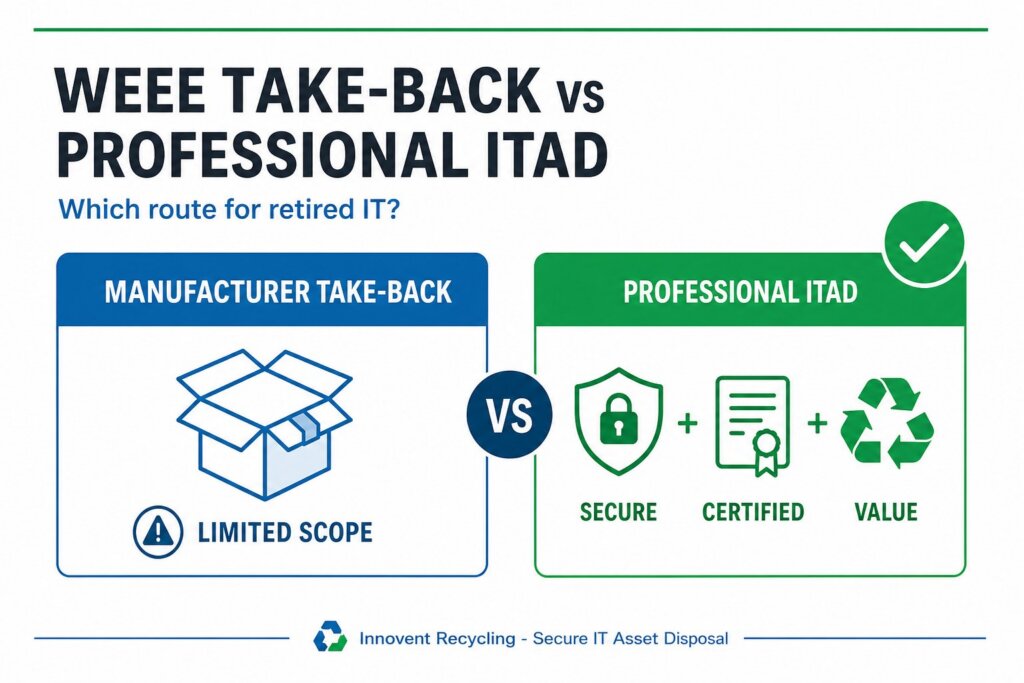
Manufacturer WEEE take-back is free in many cases, and UK law requires it in some. But free take-back is a recycling route, not an audit trail. It rarely includes certificates of destruction, serial-level reporting or rebates. Professional ITAD adds those controls — and for data-bearing IT, that difference matters more than the collection cost.
Key facts at a glance
- Under the WEEE Regulations 2013, producers must finance the recycling of business equipment they placed on the market on or after 13 August 2005
- Older kit is only the producer's problem if you replace it like-for-like with their new equipment
- Producers do not have to pay for transport from your site — and contracts often shift responsibility back to you
- Free take-back schemes almost never provide certificates of destruction or serial-level reporting
- Data removal is usually your responsibility before equipment is handed to a take-back scheme
- Professional ITAD adds certified data destruction, asset reports and buyback rebates — often at no charge
What is manufacturer WEEE take-back?
Manufacturer take-back is a scheme where the company that made or supplied your equipment takes it back for recycling when you have finished with it. Most major IT brands run one. Dell, HP and Lenovo all offer take-back or recycling routes, and some add paid "asset recovery" tiers for corporate customers. Retailers have separate duties: when they sell you a new device, they must accept your old equivalent one free of charge. These schemes exist because UK law makes producers responsible for financing the treatment of waste electrical and electronic equipment (WEEE). The free tiers are usually simple. You box up the kit, print a label or book a pallet collection, and the scheme routes it to a recycling partner. That works well for waste. It works poorly for anything that holds data or resale value, because the scheme's job ends at compliant recycling — not at evidence.
Isn't manufacturer take-back free by law?
Yes — in defined cases UK law entitles businesses to free take-back, and any honest comparison should start there. Under the WEEE Regulations 2013, producers must finance the collection, treatment and recycling of non-household WEEE they placed on the market on or after 13 August 2005. Older "historic" equipment becomes their responsibility only when you replace it like-for-like with their new kit. There are two catches. First, the producer does not have to pay for transport from your site, so "free" often excludes the part that costs you effort. Second, supply contracts frequently pass disposal responsibility to the buyer, which is legal and very common in B2B sales. Distributor take-back — the in-store, like-for-like obligation most people have heard of — applies to WEEE from private households, not to a company clearing 200 laptops. So the entitlement is real, but narrower than it sounds.
What do free take-back schemes not include?
Free take-back moves your equipment; it does not evidence what happened to your data. That is the core gap, and it shows up in five places:
- No certificates of destruction. Recycling schemes confirm tonnage was treated, not that drive serial X was wiped or shredded.
- Data is your problem. Most scheme terms state that data removal is the customer's responsibility before handover. If a drive ships with live data, the risk stays with you.
- No serial-level audit trail. You get a waste transfer note at best, not an asset-by-asset report an auditor can check.
- No rebate. Any residual value in the equipment stays with the scheme, not with you.
- Their timetable, not yours. Mail-back boxes, pallet minimums and fixed collection windows suit the recycler, not your decommissioning plan.
None of this makes take-back bad. It makes it a waste route, priced and designed as one.
What does professional ITAD include?
Professional IT asset disposal treats every device as a data risk and an asset, not just waste. The process is built around evidence. Equipment is counted and labelled with a job number at collection, logged by serial number at the facility, and closed out with serial-matched certificates and asset reports. Drives are wiped to NIST 800-88 or physically destroyed to HMG Infosec Standard 5 (Enhanced), depending on the sensitivity of the data — the same choice explained on our secure data destruction page. Working equipment is tested and resold, and the resale value comes back to you as a rebate through IT equipment buyback. At Innovent, collection is free nationwide and scheduled around your site, we operate as a registered Waste Carrier with a T11 exemption, our processes are ISO 27001 certified, and nothing we handle goes to landfill. The output is a file you can hand to an auditor, not a promise.
How do manufacturer take-back and ITAD compare?
The table below compares the free manufacturer or distributor route with a professional ITAD service on the points that matter to a UK business.
| Factor | Manufacturer WEEE take-back | Professional ITAD |
|---|---|---|
| Cost | Free in qualifying cases; transport often excluded | Free collection; rebates can make it cost-positive |
| Data destruction | Usually your responsibility before handover | NIST 800-88 wiping or HMG IS5 (Enhanced) destruction included |
| Certificates | Waste transfer paperwork at best | Serial-matched certificates of destruction |
| Asset reporting | None, or tonnage only | Serial-level asset report for every device |
| Residual value | Retained by the scheme | Returned to you as a buyback rebate |
| Collection | Mail-back or fixed slots; pallet minimums common | Scheduled around your site, nationwide |
| Mixed brands | One scheme per producer | All brands in a single collection |
| Audit evidence | Weak for UK GDPR accountability | Designed for it |
When is manufacturer take-back the right choice?
Manufacturer take-back is genuinely the right answer for some disposals, and a trustworthy ITAD provider should say so. Use it when the equipment holds no data and no meaningful value: keyboards, mice, cables, brackets and out-of-warranty accessories. Use it when you are buying like-for-like replacements and the producer will collect the old units as part of the deal — that is exactly what the regulations were written for. It also suits staff disposing of personal devices at home, where retailer take-back and council WEEE sites are the sensible route. Finally, if you already pay an OEM for a corporate asset recovery contract that includes verified data sanitisation and serial reporting, and you have read the terms, that is a form of ITAD — just check what evidence you actually receive. The dividing line is simple: no data, no value, no audit need? Take-back is fine.
When do you need professional ITAD instead?
Choose professional ITAD whenever equipment holds data, carries resale value, or needs evidence behind it. Under UK GDPR you must be able to show what happened to personal data on retired devices, and "we sent the pallet back to the manufacturer" does not answer that question. Laptops, servers, drives, phones and networking kit should leave your building through a documented chain of custody that ends in a certificate. Value matters too: a three-year-old laptop fleet is stock, not scrap, and a rebate can fund part of the refresh. This applies at any scale — a school clearing an IT suite, a firm needing computer recycling in Manchester, or a data centre decommission. If that describes your next disposal, book a collection online or call 0151 355 5482 and we will schedule it around you.
How do you check what a take-back scheme really covers?
Five questions will tell you whether a free take-back offer is safe to use. Ask them before you box anything up:
- Who handles the data? Read the terms. If they say data removal is your job, you must wipe every drive to a proper standard before the courier arrives.
- What paperwork do I get? A waste transfer note is not proof of destruction. Ask if reports name each serial number.
- Who pays for transport? Many schemes are free at the gate but not from your loading bay.
- Does it cover all my brands? One producer will not take a rival's kit under its statutory duty. Mixed estates mean multiple schemes.
- What happens to working equipment? If it gets shredded, you have paid a rebate you never saw.
If any answer worries you, the disposal belongs with an ITAD provider, not a waste route.
Frequently asked questions
Is manufacturer take-back free for UK businesses?
Sometimes. Producers must finance recycling of business equipment they put on the market after 13 August 2005, and older kit when you buy like-for-like replacements. But transport from your site is excluded, and many supply contracts pass responsibility to the buyer. Check your contract before assuming the free route applies.
Do take-back schemes provide certificates of destruction?
Free take-back schemes generally do not. They confirm equipment was recycled as waste, usually by weight, not that a specific drive was wiped or destroyed. If you need serial-matched certificates for auditors or insurers, that is an ITAD service, whether bought from an ITAD firm or as a paid OEM asset recovery tier.
Who is responsible for data on devices sent to take-back?
You are. Most scheme terms make data removal the customer's responsibility before handover, and under UK GDPR the data controller keeps accountability regardless of who transports the kit. Wipe or destroy drives to a recognised standard, and keep evidence, before any device leaves your control through a recycling scheme.
Can I get money back through manufacturer take-back?
Not through the free statutory routes — any residual value stays with the scheme. Some OEMs offer paid asset recovery with partial value return. An independent buyback service typically works harder for resale value because that is its business model, and rebates are paid against a serial-level asset report.
Does distributor take-back apply to business IT equipment?
No. The in-store and like-for-like take-back duties that retailers carry apply to WEEE from private households. Business IT estates fall under producer obligations instead, which are narrower and often varied by contract. A company clearing office equipment cannot simply return it to the shop it came from.
Is take-back or ITAD better for the environment?
Both route equipment away from landfill, but reuse beats recycling. Take-back schemes shred and recover materials; ITAD tests and resells working devices first, which keeps them in use for years. Innovent processes everything at a solar-powered facility in Ellesmere Port with a zero-landfill policy, reselling wherever possible.