
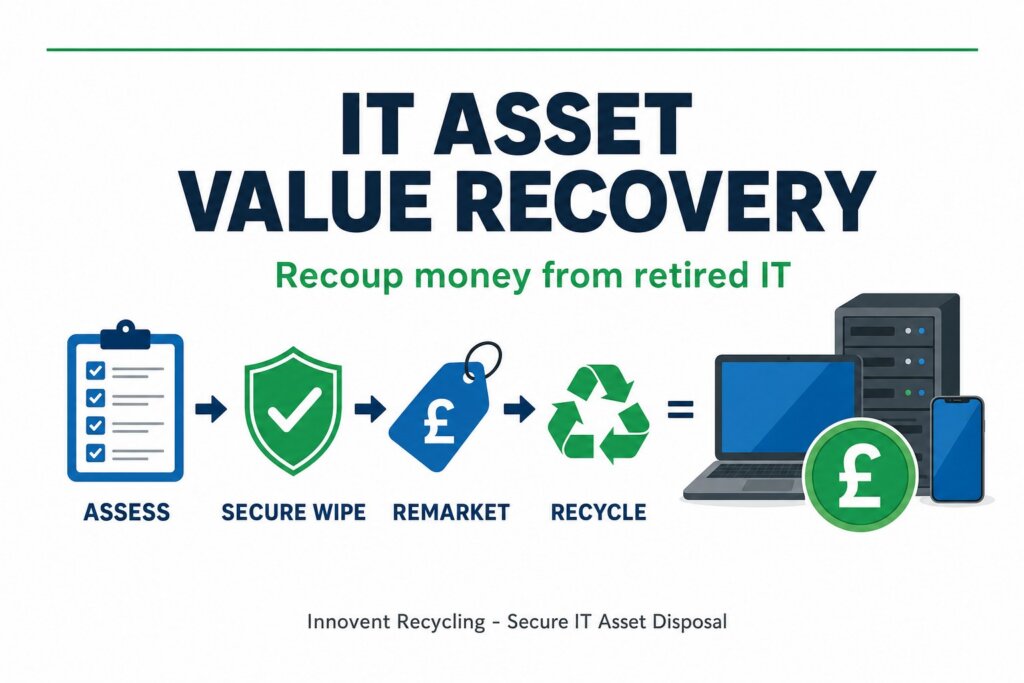
IT Asset Value Recovery: How to Recoup Money From Retired IT
Most UK businesses treat end-of-life IT as a cost to dispose of. Done properly, IT asset value recovery turns that same equipment into a cheque, a smaller carbon footprint and a clean audit trail.
- Why your Windows 10 refresh just created a pile of value
- Which retired assets are actually worth money
- How resale and data security work together, not against each other
- How a revenue-share ITAD arrangement actually pays out
Quick Summary: IT Asset Value Recovery in Plain Terms
Short on time? Here's what every IT, finance or procurement lead needs to know about IT asset value recovery:
- Retired does not mean worthless. Three-to-five-year-old laptops, servers and network kit still hold real resale value on the secondary market.
- The refresh wave is now. The Windows 10 end-of-support cycle has pushed a record volume of business hardware out of service in 2026.
- Security is the gate, not the blocker. Verified data erasure to a recognised standard is what makes an asset safe to resell, not a reason to shred everything.
- Value recovery and ESG pull the same way. Reuse keeps embodied carbon in service and feeds your Scope 3 reporting.
- Revenue share is the usual model. A specialist remarkets the kit and returns an agreed share of the proceeds, net of processing.
- Evidence still matters. You should get a per-asset settlement report alongside data destruction certificates for anything that is destroyed rather than resold.
When a fleet of laptops or a rack of servers reaches the end of its life with your business, the default reaction is to think about the cost of getting rid of it. Skip hire, a disposal invoice, a compliance headache. That instinct quietly throws money away, because a large share of retired business IT still has a market price. IT asset value recovery is the discipline of capturing that price safely, instead of paying to make it disappear.
The timing has rarely mattered more. The end of support for Windows 10 in October 2025 triggered one of the largest corporate hardware refreshes in years, and through 2026 that displaced equipment is leaving businesses in volume. A great deal of it is three to five years old, fully working, and worth a meaningful sum on the secondary market, yet much of it is being shredded or skipped by organisations that never stop to ask what it is worth.
This guide explains what IT asset value recovery actually involves, which assets are worth recovering, how resale is reconciled with your data security and compliance obligations, and what a fair commercial arrangement looks like. If you would rather hand the whole process to a specialist, Innovent's IT asset disposal service recovers value where it exists and securely recycles the rest, with the documentation built in.
What IT Asset Value Recovery Actually Means
Value recovery is the part of IT asset disposal concerned with getting money back from equipment you no longer need, rather than simply destroying it. It sits alongside secure data destruction and recycling as the third leg of a properly run disposal process.
Reuse first, recycle second
The single biggest driver of value is reuse. A laptop that can be securely wiped and resold is worth far more whole than it is as shredded raw material. Good IT asset value recovery therefore triages every item, keeping functional equipment in service through resale or redeployment and sending only the genuinely dead or sensitive kit for destruction and material recovery.
Where the money comes from
The secondary market for business IT is large and active. Refurbishers, resellers and end users buy ex-corporate laptops, desktops, servers, networking gear and even components such as memory and drives. Because business hardware is typically higher specification and better maintained than consumer kit, it holds its value comparatively well, which is exactly why value recovery is worth doing rather than assuming everything is scrap.
Why it is not just selling things
The reason value recovery is a specialist job, not an eBay listing, is everything that has to happen first. Each asset has to be inventoried, data-bearing devices have to be securely erased and verified, items have to be graded and tested, and the whole chain has to be documented. Get any of that wrong and a resale becomes a data breach. Done correctly, it is found money.
Why 2026 Is the Year to Take This Seriously
Two forces are converging to make IT asset value recovery unusually worthwhile right now: a wave of retiring hardware and a rising regulatory interest in what happens to it.
The Windows 10 refresh has flooded the pipeline
With Windows 10 out of mainstream support, organisations that delayed upgrading have moved in 2026, replacing fleets that are still perfectly serviceable as hardware. Much of this equipment fails the new operating system's requirements yet runs flawlessly, which makes it ideal for resale into markets and uses where that is no barrier. The volume means there is real value sitting on loading bays across the country.
Sustainability reporting rewards reuse
The embodied carbon in a laptop or server, the emissions from manufacturing it, dwarfs the footprint of running it. Extending an asset's life through resale keeps that carbon working instead of writing it off, which is why value recovery and your environmental targets pull in the same direction. Our guide to ITAD and ESG covers how disposal decisions feed directly into Scope 3 reporting.
Boards are paying attention
IT asset disposal has moved from a back-office afterthought to a board-level concern, driven by data risk, cost pressure and ESG scrutiny at once. As we set out in our analysis of why ITAD is now a board-level priority, the organisations getting this right are the ones treating retired IT as an asset to manage rather than a problem to bury.
Which Retired Assets Are Worth Recovering
Not everything has resale value, but more does than most people assume. Knowing where the value sits helps you avoid both throwing money away and over-investing in worthless kit.
Laptops, desktops and workstations
Business laptops are the strongest category for IT asset value recovery. Three-to-five-year-old machines from the major brands have a ready market once securely wiped and graded. Desktops and engineering workstations hold value too, particularly higher-specification units with discrete graphics or large memory configurations.
Servers, storage and networking
Data-centre and server-room equipment can carry significant residual value, both as complete units and as components such as processors, memory and drives. The catch is that it is often the most data-sensitive kit you own, so secure handling is non-negotiable. Our server disposal and decommissioning guide covers the process in detail.
Phones, tablets and the long tail
Mobile devices retain value well and are quick to remarket once wiped. Beyond the obvious, monitors, docking stations and peripherals add up across a large estate. Even where individual items are low value, recovering them together reduces what you would otherwise pay to dispose of, and keeps usable equipment out of the waste stream.
How Value Recovery and Data Security Work Together
The most common objection to reselling retired IT is the fear of a data breach. It is a fair concern, and it is exactly why value recovery has to be built on a foundation of verified data destruction. Handled properly, security enables resale rather than preventing it.
Erase to a standard, then resell
An asset destined for reuse is securely erased to a recognised standard and verified before it is graded for resale. Wiping a working drive and reselling the device captures its value while leaving no recoverable data behind. Destruction is reserved for media that cannot be reliably erased or data too sensitive to risk, as our comparison of shredding versus wiping explains.
You stay responsible until the data is gone
Under UK GDPR your organisation remains the data controller until the data is destroyed, whether the device is shredded or resold. That responsibility does not transfer just because the kit has left the building, and the ICO's security guidance treats secure disposal as part of that duty. This is why value recovery only belongs with a provider who treats certified data destruction as the first step, not an optional extra bolted onto a resale.
Evidence for everything
A trustworthy value recovery process documents both halves of the job. You should receive a serial-numbered certificate of data destruction for assets that are destroyed, and a per-asset settlement report for those that are resold, all tied to an auditable chain of custody. That paper trail is what lets you put a value recovery programme in front of an auditor with confidence.
The Commercial Model, and a Value Recovery Checklist
Most IT asset value recovery runs on a revenue-share model: the specialist collects, wipes, grades and remarkets your equipment, then returns an agreed share of the resale proceeds after processing costs. For higher-value, larger estates a fixed buy-back price is sometimes offered instead. Either way, the arrangement should be transparent and documented per asset.
If your organisation is retiring IT this year, work through this:
- Inventory before you bin anything. You cannot recover value from kit that has already been skipped. Capture what is leaving and its rough age and specification.
- Triage for reuse first. Separate working equipment that can be resold from genuinely dead or highly sensitive kit destined for destruction.
- Insist on verified erasure. Every data-bearing device resold must be wiped to a recognised standard and verified, not just formatted.
- Agree the commercial terms up front. Understand the revenue-share percentage or buy-back basis, and what counts as a processing cost.
- Demand evidence per asset. Destruction certificates for what is destroyed, a settlement report for what is sold, and a chain of custody throughout.
- Count the carbon, not just the cash. Record reused volumes for your sustainability reporting, where reuse is the strongest outcome.
If that feels like a lot to manage in-house, it is precisely the job a certified ITAD partner exists to take off your plate, with both the resale and the compliance handled together.
Frequently Asked Questions
What is IT asset value recovery?
IT asset value recovery is the process of recouping money from retired business IT by securely wiping, grading and reselling working equipment, instead of paying to have it destroyed. It sits alongside data destruction and recycling within IT asset disposal, prioritising reuse so that functional kit returns value rather than becoming scrap.
Is it safe to resell old business laptops and servers?
Yes, provided every data-bearing device is securely erased to a recognised standard and verified before resale. Done correctly there is no recoverable data left on the device. Under UK GDPR you remain the data controller until the data is destroyed, so value recovery should only be carried out by a provider that treats certified data destruction as the first step.
Which retired IT assets are worth the most?
Business laptops from the major brands hold value best, followed by higher-specification desktops and workstations, servers, storage and networking equipment, and mobile devices. Even where individual items are low value, recovering them together across a large estate reduces disposal costs and keeps usable equipment out of the waste stream.
How does the revenue-share model work?
In a revenue-share arrangement, the ITAD specialist collects, securely wipes, grades and remarkets your equipment, then returns an agreed percentage of the resale proceeds after processing costs. For larger or higher-value estates, a fixed buy-back price is sometimes offered instead. The terms should be transparent and reported per asset.
Does value recovery help with sustainability targets?
Yes. Most of an IT asset's carbon footprint is embodied in its manufacture, so extending its life through reuse keeps that carbon in service rather than writing it off. Reused volumes feed directly into Scope 3 reporting, which is why IT asset value recovery and environmental targets reinforce one another.
What evidence should I receive from a value recovery process?
You should receive a serial-numbered certificate of data destruction for any asset that is destroyed, a per-asset settlement report for equipment that is resold, and an auditable chain of custody across the whole process. This documentation is what allows a value recovery programme to stand up to an auditor or regulator.
About Innovent Recycling
Innovent Recycling is a UK-based specialist in secure IT asset disposal and recycling. With ISO 27001 certification and Environment Agency T11 exemption, we recover value from working equipment, destroy data-bearing media to a recognised standard, and recycle the rest responsibly for businesses across the United Kingdom.
Our services include:
- Certified Data Destruction - HMG Infosec Standard 5 compliant erasure and shredding for HDDs and SSDs
- Computer & IT Recycling - Secure, compliant disposal of all IT assets
- WEEE Compliance Management - Full regulatory compliance and documentation
- Nationwide Collections - Free collection service available UK-wide
Trusted by businesses across the UK for secure, compliant IT disposal. View our accreditations and certifications.
Sitting on Retired IT? Find Out What It's Worth
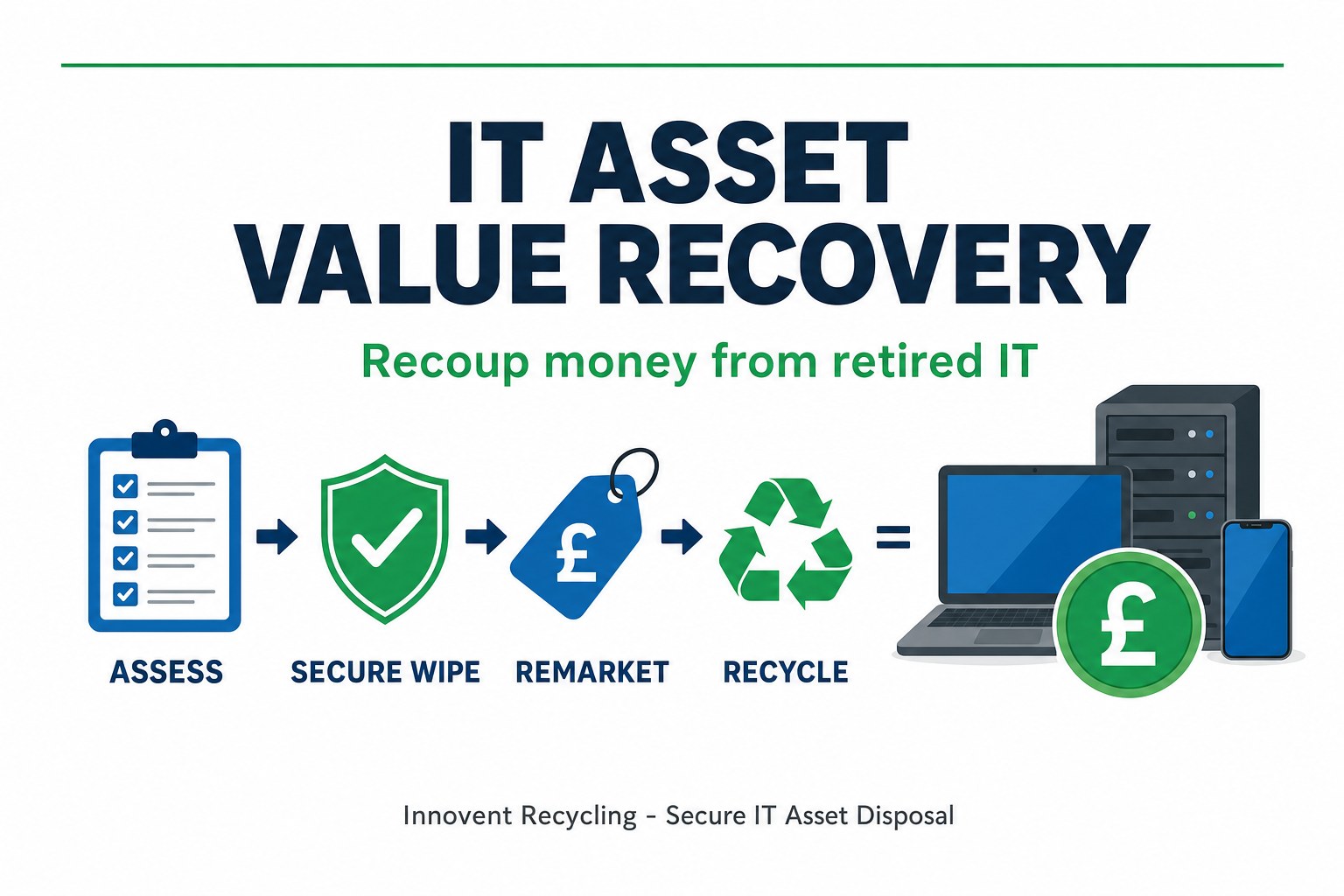
We securely wipe, remarket and recycle your end-of-life IT, returning the value where it exists and a certificate of destruction for everything else, with free UK collection.
Request a Free Value Recovery Quote
Or call us on 0151 355 5482