
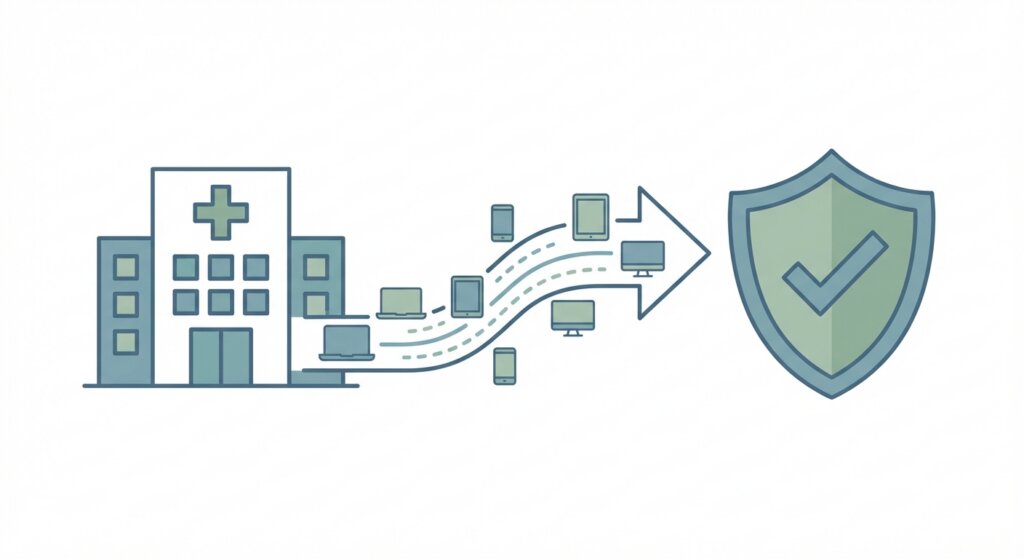
How Do You Securely Dispose of 2,000+ Devices Containing Patient Data?
When a leading NHS Trust in the North West of England faced the challenge of retiring over 2,147 end-of-life PCs, laptops, and tablets, they needed more than just a standard IT recycling service. They needed absolute certainty that every byte of patient data would be irreversibly destroyed, with full compliance documentation for their Data Security and Protection Toolkit (DSPT) submission.
The Challenge
- 2,147 devices across 12 hospital sites and community clinics
- Sensitive patient data requiring certified destruction to NHS Digital standards
- DSPT compliance demanding a complete audit trail with individual asset tracking
- 3-week deadline before new equipment arrived
- Budget constraints requiring a cost-neutral solution
Previous disposal attempts through local providers had resulted in incomplete documentation and delays. The Trust needed a partner who could handle the full scope professionally.
Our Solution
Innovent Recycling designed a bespoke disposal programme tailored to NHS requirements:
Secure Collection: GPS-tracked vehicles collected equipment from all 12 sites on a pre-agreed schedule. Every device was logged with a unique asset tag, with chain-of-custody documentation at each location.
ISO 27001 Data Destruction: All drives underwent certified data destruction at our secure facility. Devices were wiped to NIST 800-88 Purge standard, with physical shredding for drives that could not be wiped. Every event was logged with serial numbers, timestamps, and destruction method.
Individual Certificates: Each data-bearing device received an individual certificate of data destruction, cross-referenced to the Trust's asset register for DSPT compliance.
Responsible Recycling: All equipment was processed under our T11 exemption and Waste Carrier Licence with a strict zero-landfill policy.
The Results
"Innovent made the entire process seamless. The individual certificates gave us exactly what we needed for our DSPT submission, and the fact that everything was completed in three weeks was remarkable given the scale."
— IT Director, NHS Trust
Key Takeaways
- NHS organisations need granular, per-device destruction certificates for DSPT compliance
- Multi-site collections require careful logistics planning and chain-of-custody documentation
- Cost-neutral disposal is achievable when working with a provider who recovers residual value
- ISO 27001 certification provides the assurance NHS data governance teams require
Inside the NHS Trust Data Destruction Process
Disposing of IT for an NHS trust is fundamentally different from a standard office clearance. Every laptop, desktop, and tablet is treated as a potential carrier of special category patient data under UK GDPR, which means destruction has to be evidenced to a standard that survives scrutiny from NHS Digital, the Information Commissioner’s Office, and the trust’s own Caldicott Guardian. We built the programme around three phases so nothing was left to chance.
Phase 1 – Discovery and asset reconciliation. Before a single device left site, our team reconciled the trust’s asset register against what was physically present in each of the 12 locations. Ghost assets — devices recorded as retired but still live, or live devices missing from the register — are the single biggest cause of failed Data Security and Protection Toolkit (DSPT) submissions, so closing that gap first protected the trust’s audit position.
Phase 2 – Controlled collection. Community clinics and smaller sites rarely have secure staging areas, so we scheduled collections to minimise the time equipment sat unattended. Each data-bearing device was labelled with the job number at the point of collection, recorded on a signed collection count, and loaded onto our GPS-tracked vehicles, creating an unbroken chain of custody from the ward to our facility.
Phase 3 – Destruction and certification. Drives that could be sanitised were wiped to NIST 800-88 Purge and verified; anything that failed verification was physically shredded. Crucially, every outcome was tied back to an individual serial number, so the trust received a per-device certificate rather than a single blanket statement — the level of granularity DSPT assessors now expect.
What NHS Data Governance Teams Should Plan For
The lesson other NHS organisations can take from this NHS trust project is that the documentation requirement, not the destruction itself, is usually the hard part. Wiping a drive is a solved problem; proving, asset by asset, that it happened to the right standard at the right time is where most disposals come unstuck. Building the evidence model first — agreeing what a complete record looks like before any equipment moves — saves a scramble at audit.
Map devices to the right risk tier. Not every asset carries the same exposure. Clinical systems and shared workstations holding live patient records sit at the top of the risk register, while meeting-room laptops may hold very little. Segmenting the estate this way lets a trust apply physical destruction where the stakes justify it and verified erasure elsewhere, without over-spending or under-protecting.
Align timelines to clinical operations. Hospitals cannot pause care for an IT refresh, so collections were scheduled around ward routines and clinic hours rather than a vendor’s convenience. That coordination is what allowed all 12 sites to be cleared inside three weeks without disrupting front-line services.
Finally, keep the destruction certificates somewhere your DSPT assessor can actually reach them. A complete pack that lives in an inaccessible inbox helps no one; indexing it against the asset register, as we did here, is what turns a pile of PDFs into defensible evidence.
NHS Trust IT Disposal: Frequently Asked Questions
What data destruction standard does an NHS trust need?
There is no single mandated technical standard, but NHS Digital guidance points organisations toward recognised methods such as NIST 800-88 for sanitisation and physical destruction for media that cannot be verified. The practical test is whether your DSPT evidence shows that data was rendered irretrievable and that you hold proof for every asset. Per-device certificates referencing serial numbers are the most defensible form of evidence.
How does IT disposal support a DSPT submission?
The Data Security and Protection Toolkit requires NHS organisations to demonstrate that hardware holding personal data is disposed of securely. A compliant disposal partner supplies waste transfer notes, a chain-of-custody record, and individual destruction certificates that can be attached directly to the relevant DSPT assertions, removing a common source of audit findings.
Can a hospital IT refresh be cost-neutral?
Often, yes. Where retired equipment still holds residual value — recent laptops, monitors, and networking kit — that value can be recovered through refurbishment and offset against the cost of secure collection and destruction. For this trust, residual value recovery covered the full programme, delivering compliant disposal at no net cost.
Ready to Discuss Your IT Disposal Project?
Whether you are managing a small office refresh or a large-scale decommission, Innovent Recycling provides the same level of security, compliance, and professionalism.